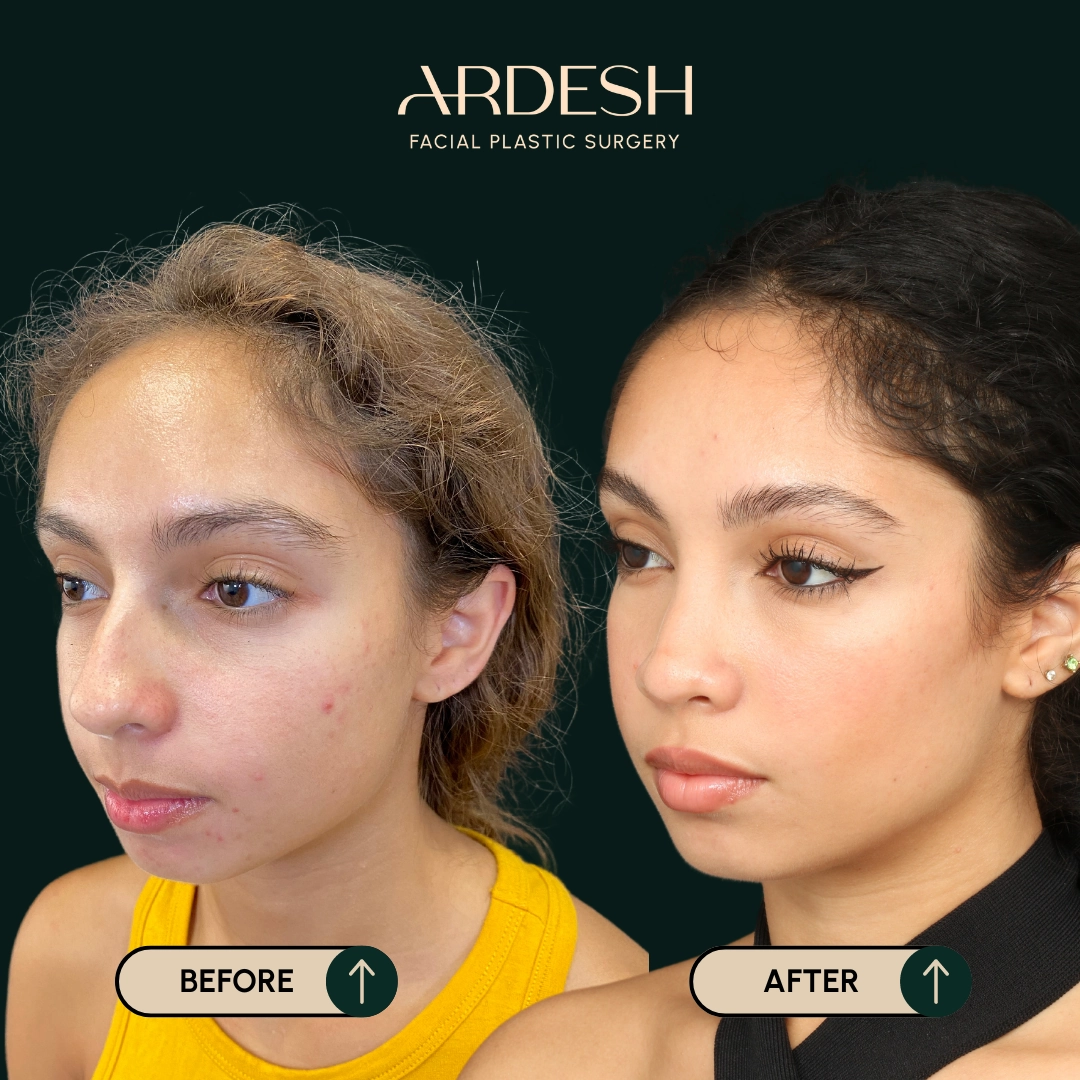
For decades, changing a prominent nasal bridge often meant reducing it from the top and then reconstructing the surrounding structures. Preservation rhinoplasty approaches the problem differently. Instead of automatically removing and rebuilding the natural bridge, the surgeon may preserve important parts of it while changing the structures underneath. For suitable patients considering rhinoplasty nose surgery, this can provide another way to achieve a more balanced profile while retaining more of the nose's original anatomy.
The word "preservation" is important, but it can also be misunderstood. It does not mean nothing is changed. It means the surgical plan is designed to preserve selected structures whenever the patient's anatomy allows it.
About Dr. Ardesh
Dr. Ardesh of Beauty Mark MD is a double board-certified facial plastic and reconstructive surgeon known for delivering thousands of refined, natural outcomes. With an academic background that includes teaching in head and neck surgery, ophthalmology, and dermatology at Loma Linda University, he later transitioned into private practice to focus on patient-centred care. His philosophy emphasises subtle enhancement rather than obvious alteration, earning him recognition as a leading plastic surgeon in Beverly Hills and Newport Beach.
What Makes Preservation Rhinoplasty Different?
Traditional rhinoplasty and preservation rhinoplasty can pursue similar cosmetic goals. The difference lies largely in how the surgeon approaches the nasal framework.
In some traditional techniques, a prominent bridge is reduced directly. Depending on the operation, the nasal bones may then need to be repositioned to create a stable, natural-looking bridge.
With preservation techniques, selected patients may instead have the bridge lowered while maintaining its natural surface.
Think of it less as rebuilding the roof and more as carefully adjusting what supports it.
This approach to nose reshaping rhinoplastyrhinoplasty surgery may help retain natural bridge lines and avoid unnecessary disruption of structures that do not need major alteration.
Does Preservation Rhinoplasty Really Avoid "Breaking" the Nose?
This is where the terminology needs some context.
Preservation rhinoplasty should not be interpreted as a promise that the nasal bones are never cut or repositioned. Different noses require different surgical manoeuvres.
Instead, the key principle is preserving the natural dorsal, or bridge, structure when appropriate rather than routinely removing the hump from its surface and reconstructing it.
During rhinoplasty surgery, the surgeon may work with bone, cartilage, or both depending on what needs correction. The exact technique should therefore be selected according to the patient's anatomy rather than the name of a particular procedure.
Why Preserving the Natural Bridge Can Matter
The nose is a three-dimensional structure. Changing one area can influence how another part looks and functions, which is why careful surgical planning is essential.
Preserving suitable structures may offer several advantages:
- Maintains more of the patient's natural nasal anatomy
- Can retain smooth natural lines along the bridge
- Allows targeted correction rather than unnecessary reconstruction
- Supports subtle changes that remain in proportion with the face
- Can be combined with appropriate tip refinement when needed
The objective of rhinoplasty nose surgery is not simply to make a nose smaller or straighter. A successful surgical plan should consider how the nose relates to the patient's other facial features.
Who Might Be a Candidate?
Preservation techniques are not automatically suitable for everyone seeking rhinoplasty.
A surgeon must assess the shape and height of the bridge, nasal bones, cartilage, tip, skin characteristics, previous procedures, and the patient's desired outcome.
Someone seeking nose reshaping rhinoplasty may be considered for a preservation approach when their existing anatomy allows the bridge to be maintained while addressing the concern underneath it.
Other patients may benefit more from conventional structural techniques. This does not make one approach superior to the other. It means rhinoplasty should be tailored to the individual nose.
What About the Nasal Tip?
The bridge is only one part of the overall result.
Some patients are concerned about both a dorsal hump and a nasal tip that appears wide, droopy, asymmetric, or out of proportion. In these situations, bridge preservation can form one part of a wider surgical plan.
During rhinoplasty surgery, tip cartilage can be assessed separately and refined when appropriate. The surgeon must consider how changes to the bridge and tip will work together from both front and profile views.
This whole-nose perspective is especially important when the goal is a natural result rather than a nose that looks surgically altered.
Why Surgical Planning Matters More Than the Technique's Name
It can be tempting to choose a procedure because a newer technique sounds less invasive or more advanced. Rhinoplasty is more nuanced than that.
Two patients asking for the same change can have completely different internal and external nasal structures. The best approach to rhinoplasty nose surgery therefore depends on what needs to change and what should be preserved.
A detailed consultation also gives patients an opportunity to explain what they do not want. For many people, that means avoiding an overly small, upturned, or artificial-looking nose.
When planning nose reshaping rhinoplasty, maintaining facial identity can be just as important as correcting the feature that brought the patient to the consultation.
Preserving What Already Works
Preservation rhinoplasty reflects an important principle in modern nasal surgery: not every structure needs to be changed simply because one part of the nose is being corrected. When appropriate, preserving natural anatomy while making carefully planned adjustments can support balanced, individualised results.
Dr. Farhad Ardesh offers personalised rhinoplasty surgery planning based on each patient's facial anatomy and cosmetic goals. A consultation can help determine which surgical approach is appropriate while keeping natural-looking facial balance at the centre of the plan.
FAQs
1. Is preservation rhinoplasty the same as traditional rhinoplasty?
No. Both can reshape the nose, but preservation techniques aim to retain selected natural structures, particularly the nasal bridge, when the patient's anatomy makes this appropriate.
2. Can preservation rhinoplasty make a dorsal hump less noticeable?
In suitable patients, preservation techniques can lower a prominent bridge without treating it in exactly the same way as traditional hump-removal techniques.
3. Does preservation rhinoplasty involve no bone cutting at all?
Not necessarily. Some surgical plans may still require work on the nasal bones. "Preservation" refers to conserving important anatomical structures where possible, not avoiding every surgical manoeuvre.
4. Can the nasal tip be changed during preservation rhinoplasty?
Yes. If appropriate for the patient's goals and anatomy, tip refinement may be incorporated into the overall surgical plan.
5. How do I know which rhinoplasty technique is right for me?
That decision requires an individual assessment of your nasal anatomy, facial proportions, concerns, and desired changes. A consultation with a qualified facial plastic surgeon can determine whether preservation or another rhinoplasty approach is more suitable.