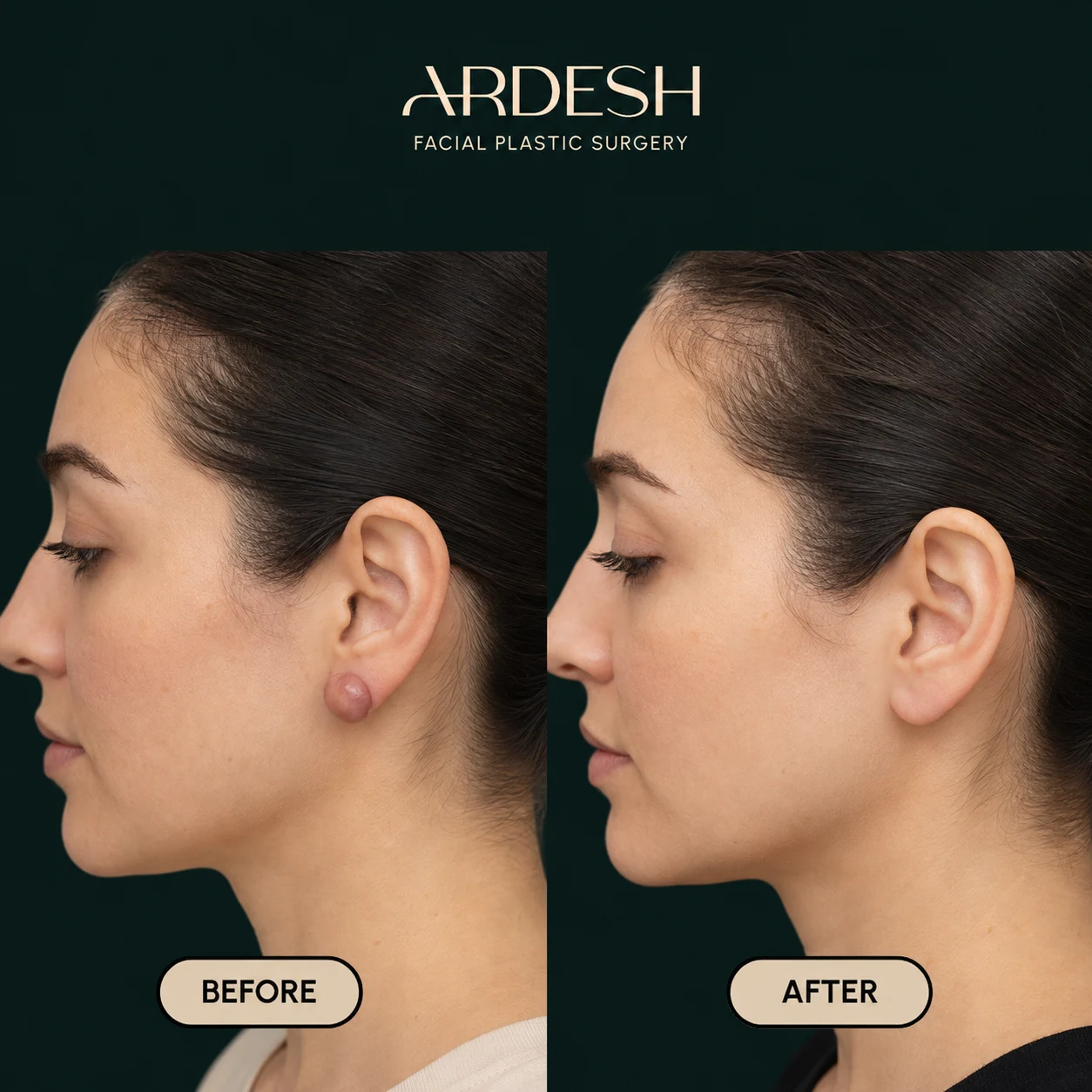
You had an ear keloid removed. The area healed, the lump disappeared, and everything seemed fine. Then the scar started feeling firm again. It may have begun itching, thickening, or slowly becoming raised.
For patients who experience this, the obvious question is: Why did my ear keloid come back even after it was removed?
The answer lies in how keloids form. Surgery can remove the existing scar, but it does not necessarily change the body's tendency to produce excessive scar tissue. This is why managing the healing period after removal can be just as important as removing the keloid itself.
About Dr. Ardesh
Dr. Ardesh of Beauty Mark MD is a double board-certified facial plastic and reconstructive surgeon known for delivering thousands of refined, natural outcomes. With an academic background that includes teaching in head and neck surgery, ophthalmology, and dermatology at Loma Linda University, he later transitioned into private practice to focus on patient-centred care. His philosophy emphasises subtle enhancement rather than obvious alteration, earning him recognition as a leading plastic surgeon in Beverly Hills and Newport Beach.
Why Can a Keloid Grow Again After It Has Been Removed?
A normal scar develops as the body repairs injured skin. Once enough tissue has formed, that process usually settles down.
A keloid behaves differently. Scar tissue continues developing beyond what is required for normal healing and may extend outside the boundaries of the original injury.
Ear keloids commonly develop after piercings, trauma, surgery, burns, or other skin injuries, particularly in people who are prone to excessive scar formation.
When a keloid is surgically removed, a new wound is created in the process. In someone who is prone to keloids, the body may respond to that new injury by producing excessive scar tissue again.
This explains why successful treatment is not simply a matter of cutting away the visible lump.
What Makes Some Ear Keloids More Likely to Return?
Recurrence risk is not identical for every patient or every keloid.
A surgeon may consider factors such as:
- Whether the keloid has already returned after treatment
- Its size, thickness, and location on the ear
- How quickly it has been growing
- Previous injections or surgical procedures
- Repeated irritation or trauma
- Tension across the wound during healing
- The patient's tendency to develop abnormal scars
A first-time earlobe keloid may therefore require a different approach from a large keloid that has already been removed several times.
This history matters when deciding what should happen after removal.
Why Is Treatment After Removal So Important?
The period after surgery is when a new scar begins forming.
Rather than waiting to see whether another large keloid develops, postoperative management focuses on how the scar behaves while it is healing.
Depending on the individual case, this may include individualized skin preparation, wound-care instructions, scar management, injections, and strategies intended to reduce tension across the surgical site.
Follow-up is especially important in patients who have already experienced recurrence because changes in the scar can sometimes begin before a large lump becomes obvious.
Where Do Steroid and 5-FU Injections Fit In?
Intralesional injections may be incorporated into treatment for selected patients.
Corticosteroid injections are used in keloid management to help control excessive scar activity and may be given as part of postoperative care depending on the patient's situation.
Another option used in selected cases is 5-fluorouracil, or 5-FU. It may be incorporated alone or alongside other scar-management measures when considered appropriate by the treating surgeon.
There is no single injection schedule or treatment combination that is right for every recurrent ear keloid. Previous treatment, scar characteristics, symptoms, and the way the tissue is healing all influence the plan.
Does the Way the Ear Is Closed Affect Healing?
It can.
The ear presents a particular surgical challenge because there may be limited tissue available for reconstruction, especially after removal of a larger keloid.
If excessive tension is placed across the healing incision, it can affect the scar environment. Careful planning therefore involves not only removing abnormal tissue but also restoring the shape of the ear while avoiding unnecessary tension where possible.
Closure technique, suture selection, remaining healthy tissue, and the location of the keloid all need to be considered together.
This becomes particularly important when treating a recurrent keloid because previous procedures may already have altered the available tissue.
How Can You Tell If an Ear Keloid Is Starting to Return?
A recurrent keloid does not always reappear overnight as a large bump.
The first changes may be much subtler.
Watch for:
- A scar becoming progressively firmer
- New or increasing thickness
- Persistent itching
- Burning or irritation
- Tenderness around the treated area
- A raised area that slowly becomes larger
Not every itchy or firm scar means a keloid is returning. Healing scars naturally change over time.
However, patients with a history of ear keloids should mention persistent or progressive changes during follow-up rather than waiting until the growth becomes substantial.
What If Your Ear Keloid Has Already Come Back More Than Once?
A repeatedly recurrent keloid deserves a fresh assessment rather than automatically repeating the same treatment.
The surgeon needs to know what was done previously, how quickly the scar returned, whether injections were used, how the wound healed, and whether the keloid is now affecting the shape of the ear.
Previous scars and surgeries may also change the amount and quality of tissue available for another repair.
For that reason, a recurrent ear keloid is not simply the same problem returning. Its treatment history becomes part of the new problem and should influence the next plan.
Can You Get Your Ear Pierced Again After Keloid Removal?
Patients whose keloid developed after piercing understandably want to know whether they can wear earrings again.
A new piercing creates another wound in the skin. For someone who has already demonstrated a tendency to develop a piercing-related keloid, that needs to be considered carefully.
There is no universal answer about whether or when re-piercing is appropriate. The recommendation depends on how the ear has healed, where the original keloid developed, previous recurrence, and the individual's scar history.
Before getting the ear pierced again, it is sensible to discuss the decision with the surgeon managing the keloid.
When Should a Recurrent Ear Keloid Be Evaluated?
Consider having the ear evaluated if a previously treated scar is becoming progressively larger, firmer, itchy, painful, tender, or irritated.
An assessment is also worthwhile when a keloid has already returned after one or more procedures. At that point, understanding why previous treatment may not have succeeded becomes particularly important.
Dr. Farhad Ardesh’s Keloid Management Protocol evaluates recurrent ear keloids based on the scar itself, previous treatments, symptoms, ear anatomy, healing history, and recurrence risk.
For patients seeking ear keloid treatment in Beverly Hills, treatment may involve surgical and nonsurgical measures selected according to the individual case rather than simply repeating the previous procedure.
The objective is to improve the existing keloid while planning carefully for the healing process that follows.
Schedule a consultation with Dr. Ardesh to have a new or recurrent ear keloid evaluated and discuss an individualized treatment approach.