Earlobes are rarely the first feature people associate with aging. But over time, they can become longer, thinner, stretched, or noticeably different from how they looked years ago.
For some people, the change is subtle. For others, elongated earlobes or stretched piercing holes begin to affect how earrings sit or make the ears look less balanced with the rest of the face.
So why does this happen, and when is treatment worth considering?
About Dr. Ardesh
Dr. Ardesh of Beauty Mark MD is a double board-certified facial plastic and reconstructive surgeon known for delivering thousands of refined, natural outcomes. With an academic background that includes teaching in head and neck surgery, ophthalmology, and dermatology at Loma Linda University, he later transitioned into private practice to focus on patient-centred care. His philosophy emphasises subtle enhancement rather than obvious alteration, earning him recognition as a leading plastic surgeon in Beverly Hills and Newport Beach.
Why Do Earlobes Become Longer With Age?
Earlobes are made mainly of skin, fat, and connective tissue rather than cartilage.
As the skin ages, it gradually loses collagen and elasticity. This makes the tissue less resistant to stretching. Gravity then continues to pull on the earlobe over many years.
Several factors can make the change more noticeable:
- Natural loss of skin elasticity
- Genetics and natural earlobe size
- Years of wearing heavy earrings
- Repeated pulling or trauma to a piercing
- Significant stretching from gauges
- Previous surgery around the face or ears
Not everyone develops visibly elongated earlobes, but changes often become more noticeable with age.
Can Heavy Earrings Permanently Stretch Earlobes?
Yes, especially when heavy earrings are worn frequently over many years.
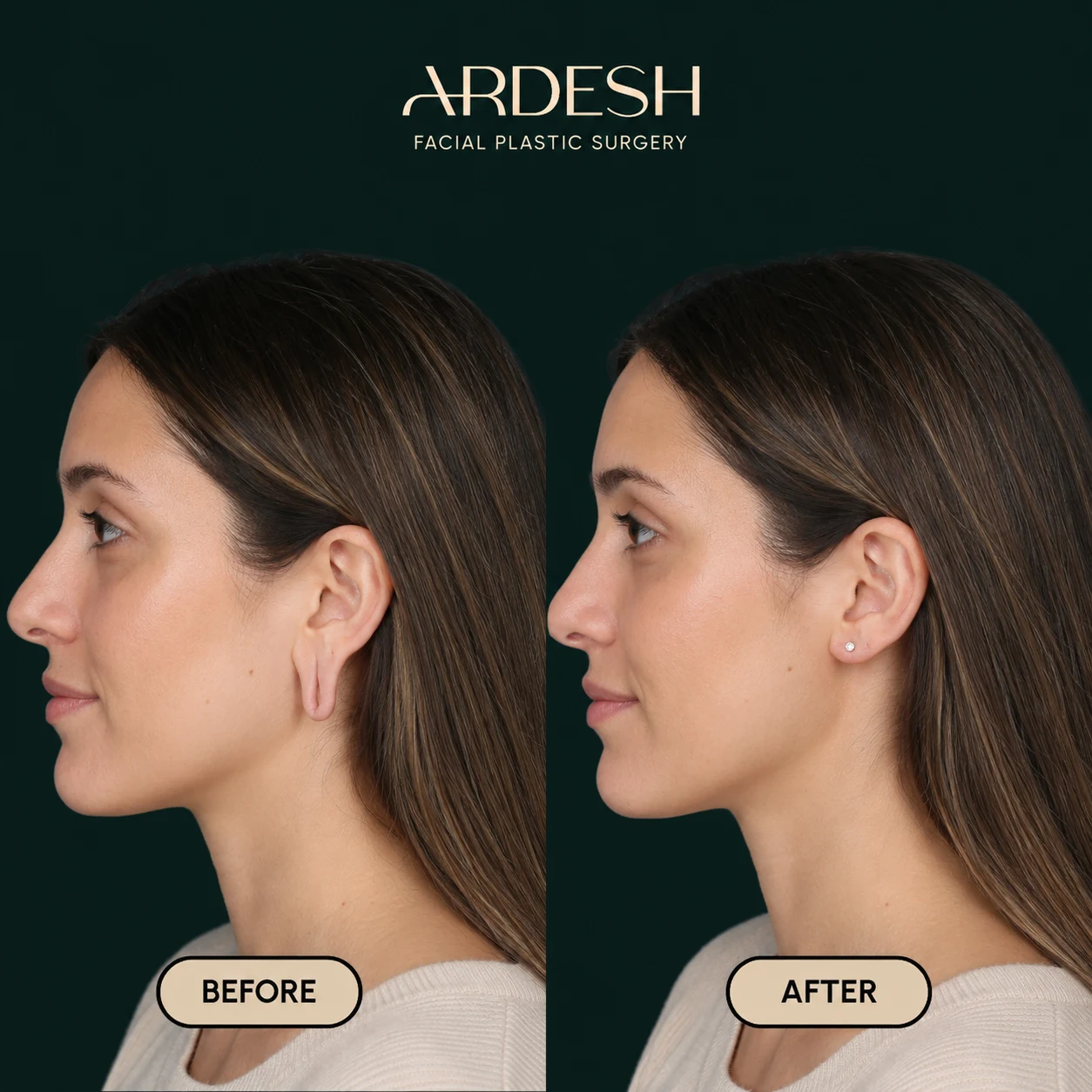
The piercing hole may gradually become longer, while the tissue underneath becomes thinner. Eventually, the opening may resemble a vertical slit instead of a small round piercing.
In more advanced cases, the remaining tissue may tear completely.
Once the tissue has significantly stretched, simply avoiding heavy earrings will not usually return the earlobe to its original shape.
Can Fillers Fix Aging Earlobes?
Sometimes, but only for certain concerns.
Dermal filler can add volume to a thin or deflated earlobe. This may help improve the appearance of mild volume loss or provide more support around an earring.
However, filler cannot shorten an earlobe that has become too long.
It also cannot properly correct:
- Excess or stretched skin
- Enlarged piercing holes
- Torn earlobes
- Major gauge-related stretching
- A pulled-down earlobe after surgery
The important question is whether the problem is primarily volume loss or excess stretched tissue.
When Does Earlobe Rejuvenation Surgery Make More Sense?
Surgical rejuvenation may be considered when the earlobe has become noticeably elongated, enlarged, stretched, or disproportionate.
During the procedure, excess tissue can be carefully reshaped to create a more natural earlobe contour.
The goal is not simply to make the earlobe smaller.
A facial plastic surgeon must also consider the patient's ear shape, facial proportions, jawline, skin quality, and how the lower ear connects with the surrounding face.
This is particularly important when earlobe rejuvenation is performed alongside facial rejuvenation procedures.
Why Can Earlobes Look More Noticeable After a Facelift?
Patients sometimes become more aware of their earlobes after improving the cheeks, jawline, or neck.
A rejuvenated face may make an elongated earlobe stand out more clearly.
There is also another concern known as a pixie ear deformity, where the earlobe appears pulled downward or attached more closely to the jawline.
This can occasionally occur after facelift surgery when tension or scar contraction affects the lower ear.
Correcting this type of problem requires attention to both the earlobe itself and the surrounding facial tissues.
What If the Earlobe Is Torn Rather Than Just Stretched?
A stretched piercing and a torn earlobe are related but different problems.
A stretched piercing still has tissue connecting the lower part of the earlobe. A complete tear creates a split through the earlobe.
Torn earlobe repair typically involves removing damaged tissue around the tear and carefully closing the area so the earlobe regains a natural contour.
Patients who want to wear earrings again usually need to allow the repaired tissue to heal before considering a new piercing.
Can Gauge-Stretched Earlobes Return to Normal?
Small gauge openings may shrink after the jewelry is removed, depending on how much the tissue has been stretched.
Larger openings often do not close completely on their own.
In these cases, surgical gauge repair may be used to remove excess stretched tissue and reconstruct the remaining earlobe.
The exact approach depends on the size of the opening, the amount of remaining tissue, and the patient's preferred earlobe shape.
When Should You Consider Having Your Earlobes Evaluated?
Treatment is largely a personal decision.
An evaluation may be worthwhile if you notice that:
- Your earlobes have become noticeably longer with age
- Earrings no longer sit properly
- A piercing hole continues to stretch
- The earlobe has partially or completely torn
- Gauge openings have not closed after removing jewelry
- The lower ear looks pulled down following facial surgery
- Your earlobes appear out of proportion after facial rejuvenation
The right treatment depends on what is actually causing the change.
Choosing the Right Treatment for Aging Earlobes
Not every aging earlobe requires surgery, and not every patient will benefit from filler.
The most appropriate approach depends on whether the concern involves volume loss, excess skin, structural stretching, a tear, or changes related to previous surgery.
Dr. Farhad Ardesh evaluates the ears as part of the overall facial structure rather than treating the earlobe as an isolated feature. For patients considering earlobe rejuvenation in Beverly Hills, this broader assessment can help determine whether nonsurgical treatment, reshaping, or repair is the most suitable option.
A consultation can also help clarify what type of improvement is realistic while preserving an earlobe shape that looks natural with the rest of the face.