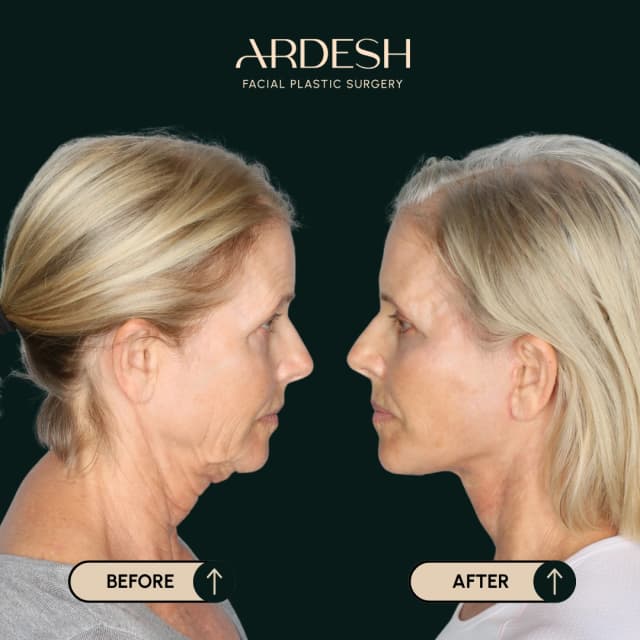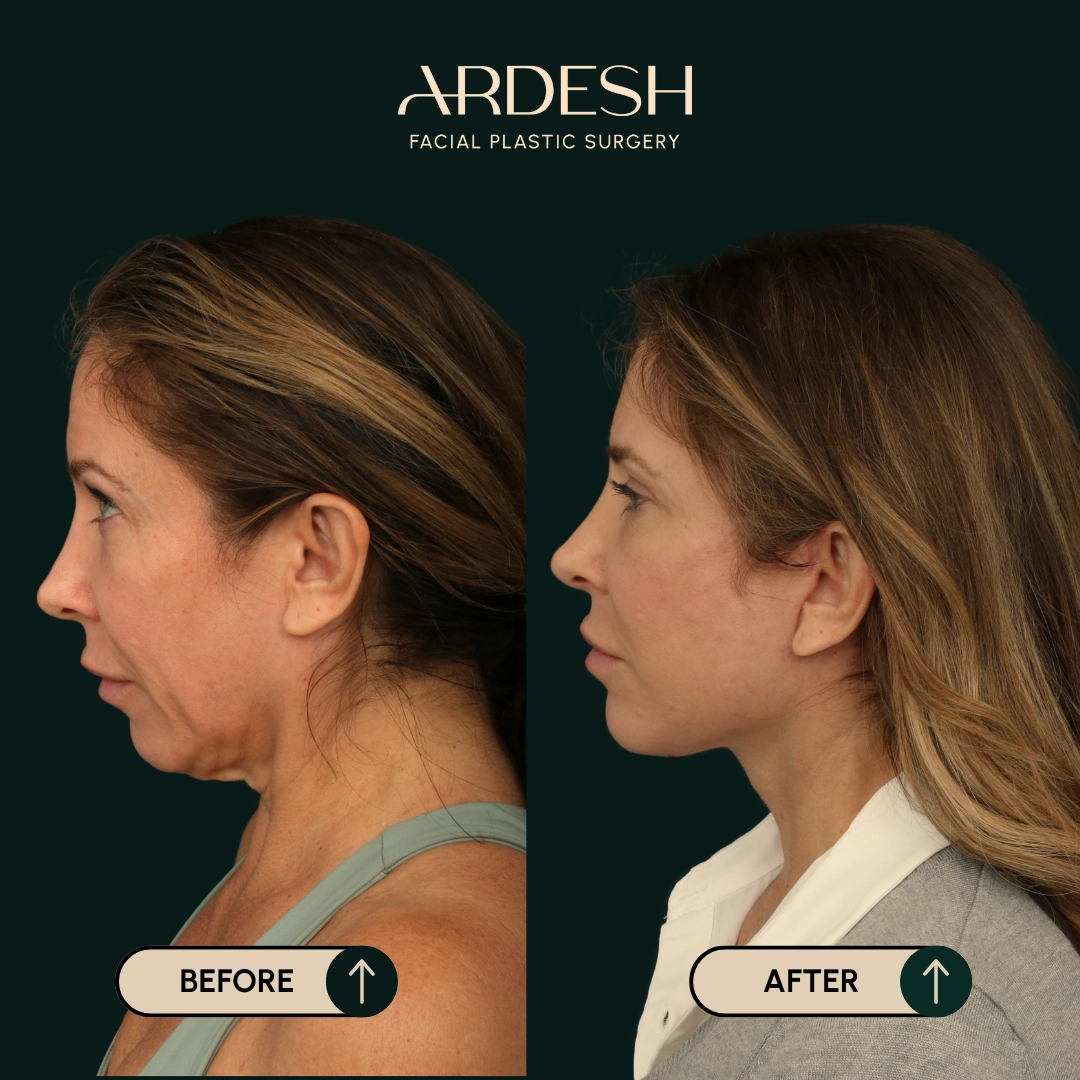
Most people assume that a "turkey neck" only develops after significant weight gain. It is one of the most common misconceptions patients bring into a consultation. The logic seems straightforward: more body fat should mean more loose skin beneath the chin and along the neck.
Yet in facial plastic surgery, we regularly see the opposite.
Many individuals who have maintained a slim physique throughout their lives still develop noticeable neck laxity, vertical neck bands, or sagging beneath the jawline. In fact, some of the most challenging cases involve patients with very little body fat.
Understanding the true turkey neck causes requires looking beyond weight and focusing on anatomy, genetics, skin biology, muscle function, and the ageing process. Once these factors are understood, it becomes clear why body weight alone rarely explains changes in the neck.
About Dr. Ardesh
Dr. Ardesh of Beauty Mark MD is a double board-certified facial plastic and reconstructive surgeon known for delivering thousands of refined, natural outcomes. With an academic background that includes teaching in head and neck surgery, ophthalmology, and dermatology at Loma Linda University, he later transitioned into private practice to focus on patient-centred care. His philosophy emphasises subtle enhancement rather than obvious alteration, earning him recognition as a leading plastic surgeon in Beverly Hills and Newport Beach.
Turkey Neck Is Primarily an Anatomical Condition
The term "turkey neck" describes the gradual loss of a smooth jawline and neck contour caused by changes in multiple tissue layers.
These changes may involve:
- Skin laxity
- Platysma muscle separation (platysmal banding)
- Loss of collagen and elastin
- Fat redistribution
- Descent of deeper facial structures
- Weak connective tissue support
Notice that excessive body fat is only one possible contributor and often not the primary one.
A slender patient may have minimal neck fat while still experiencing significant skin laxity or muscle changes that create the appearance of a sagging neck.
This is why simply losing more weight rarely improves the problem and, in some cases, can make it more noticeable.
Genetics Often Determines Neck Ageing Before Lifestyle Does
One of the most overlooked turkey neck causes is inherited anatomy.
Some individuals naturally have:
- thinner skin
- weaker collagen architecture
- reduced skin elasticity
- a naturally lower hyoid bone
- a shorter chin projection
- early platysma muscle laxity
These anatomical characteristics may become visible years before wrinkles appear elsewhere on the face.
Patients often say,
"I'm the only slim person in my family with this neck."
Interestingly, careful family history frequently reveals that parents or grandparents developed similar neck ageing despite remaining lean throughout adulthood.
Genetics influences not only when ageing appears but also where it appears first.
Collagen Loss Happens Regardless of Body Weight
Skin quality depends heavily on collagen, elastin, and extracellular matrix support.
Beginning in early adulthood, collagen production gradually declines.
With age:
- collagen fibres become thinner
- elastin loses recoil
- fibroblast activity decreases
- skin hydration reduces
- dermal support weakens
These biological changes occur whether someone weighs 50 kilograms or 100 kilograms.
A lean body cannot prevent collagen depletion.
This explains why two individuals with identical body mass may experience dramatically different rates of neck ageing.
The Platysma Muscle Plays a Bigger Role Than Most People Realise
One of the least discussed yet most significant turkey neck causes involves the platysma.
The platysma is a thin muscle extending from the chest upward across the neck into the lower face.
With ageing, this muscle may gradually separate along the midline.
Instead of remaining as one continuous sheet, the muscle edges begin pulling apart, producing the familiar vertical neck bands often associated with turkey neck.
No amount of dieting can reconnect separated muscle fibres.
When platysmal banding becomes pronounced, treatment must address the muscle itself rather than simply tightening the skin.
Facial Fat Loss Can Make the Neck Look Older
Contrary to popular belief, having very little facial fat is not always an advantage.
Healthy facial fat provides structural support.
As ageing progresses, lean patients frequently experience:
- cheek volume loss
- jawline deflation
- soft tissue descent
- increased skin redundancy
Without adequate support, loose skin becomes more visible around the jaw and neck.
Ironically, individuals with moderate facial fullness sometimes maintain smoother neck contours longer than extremely lean individuals.
Ageing is therefore a balance between volume, support, and skin quality, not simply body weight.
Weight Loss Can Reveal an Existing Problem
Patients often believe rapid weight loss caused their turkey neck.
In many situations, the weight loss simply uncovered anatomical changes that had already developed beneath the skin.
After significant fat reduction:
- previously supported skin becomes looser
- neck definition decreases
- underlying muscle bands become visible
- jawline irregularities become more apparent
Weight loss itself is not necessarily the cause.
Instead, it removes the tissue that had been masking deeper structural ageing.
Why Creams and Exercises Rarely Solve Turkey Neck
The internet is filled with promises of neck exercises, massage devices, collagen creams, and tightening gadgets.
While maintaining healthy skin is always beneficial, patients should understand their limitations.
If the underlying issue involves:
- separated platysma muscles
- significant skin redundancy
- deep tissue descent
- structural ageing
topical products cannot restore youthful anatomy.
Likewise, isolated neck exercises do not reverse age-related tissue changes.
Choosing treatment without identifying the actual anatomical cause often leads to frustration and disappointing results.
When Is a Neck Lift the Right Solution?
For patients experiencing moderate to advanced neck ageing, a neck lift may provide the most comprehensive correction because it addresses the underlying structures rather than masking them.
A modern neck lift is designed to improve:
- jawline definition
- neck contour
- platysma muscle position
- excess skin
- soft tissue support
Rather than creating an over-tightened appearance, today's techniques focus on restoring natural anatomical relationships.
The objective is not to create a different face, it is to restore harmony between the face, jawline, and neck while preserving individual identity.
Why Neck Lift Plastic Surgery Requires Facial Expertise
Not every cosmetic surgeon specialises in facial anatomy.
Successful neck lift plastic surgery requires an advanced understanding of:
- facial retaining ligaments
- cervical anatomy
- platysma muscle mechanics
- skin tension vectors
- scar placement
- long-term tissue support
The neck cannot be evaluated in isolation.
The lower face, chin projection, jawline, muscle balance, and skin quality all influence the final outcome.
This is why experienced facial plastic surgeons spend significant time analysing the entire facial framework before recommending surgery.
Each treatment plan should be individualised rather than following a standardised approach.
Understanding why a turkey neck develops is only part of the picture. The next question is whether those changes are significant enough to consider treatment. If you're unsure, our guide on The 5-Minute Mirror Test That Tells You If You Need a Neck Lift walks you through several simple observations you can make at home to better understand your neck profile before scheduling a consultation.
A Thoughtful Approach to Neck Rejuvenation
One of the defining principles of Dr. Ardesh's philosophy is treating the patient, not simply the symptom.
Some patients benefit from a standalone neck lift.
Others may achieve better facial balance through complementary procedures involving the lower face or chin.
Equally important, not every patient requires surgery immediately.
Comprehensive evaluation allows treatment recommendations to be based on anatomy, tissue quality, and realistic long-term outcomes rather than trends or unnecessary procedures.
This patient-first approach reflects the philosophy that has earned Dr. Ardesh the trust of thousands of individuals seeking natural facial rejuvenation.
Restore Definition Without Losing Your Identity
A turkey neck is not a reflection of poor fitness, excess weight, or unhealthy living. In many cases, it is the result of genetics, collagen depletion, muscle ageing, and anatomical changes that occur even in otherwise healthy, slender individuals.
Understanding the true turkey neck causes is the first step toward choosing an appropriate solution instead of chasing treatments that cannot address the underlying problem.
If you are considering a neck lift or exploring neck lift plastic surgery, your outcome depends not only on the procedure but also on the surgeon's understanding of facial anatomy and aesthetic balance.
At Dr. Ardesh Facial Plastic Surgery, every consultation begins with a detailed anatomical assessment and a personalized treatment plan designed to achieve refined, natural-looking rejuvenation. If you are searching for an affordable neck lift in Los Angeles without compromising on specialist expertise, schedule a consultation with Dr. Ardesh to understand the true cause of your neck ageing and explore evidence-based treatment options tailored specifically to your facial structure.
Frequently Asked Questions
1. Can skinny people really develop a turkey neck?
Yes. Many lean individuals develop turkey neck because of genetics, collagen loss, skin laxity, or platysma muscle changes rather than excess body fat.
2. What are the most common turkey neck causes?
The most common causes include age-related collagen loss, platysma muscle separation, inherited anatomy, skin laxity, facial volume loss, and natural tissue descent.
3. Will losing more weight improve my turkey neck?
Usually not. If the problem is caused by loose skin or muscle ageing, further weight loss may actually make neck laxity more noticeable.
4. What does neck lift plastic surgery correct?
Neck lift plastic surgery addresses excess skin, tightens the platysma muscle when appropriate, improves jawline definition, and restores smoother neck contours using advanced facial plastic surgery techniques.
5. How do I know if I am a candidate for a neck lift?
The best way to determine candidacy is through a comprehensive consultation with a facial plastic surgeon. Your skin quality, muscle anatomy, facial proportions, and aesthetic goals all influence whether a neck lift is the most appropriate treatment.