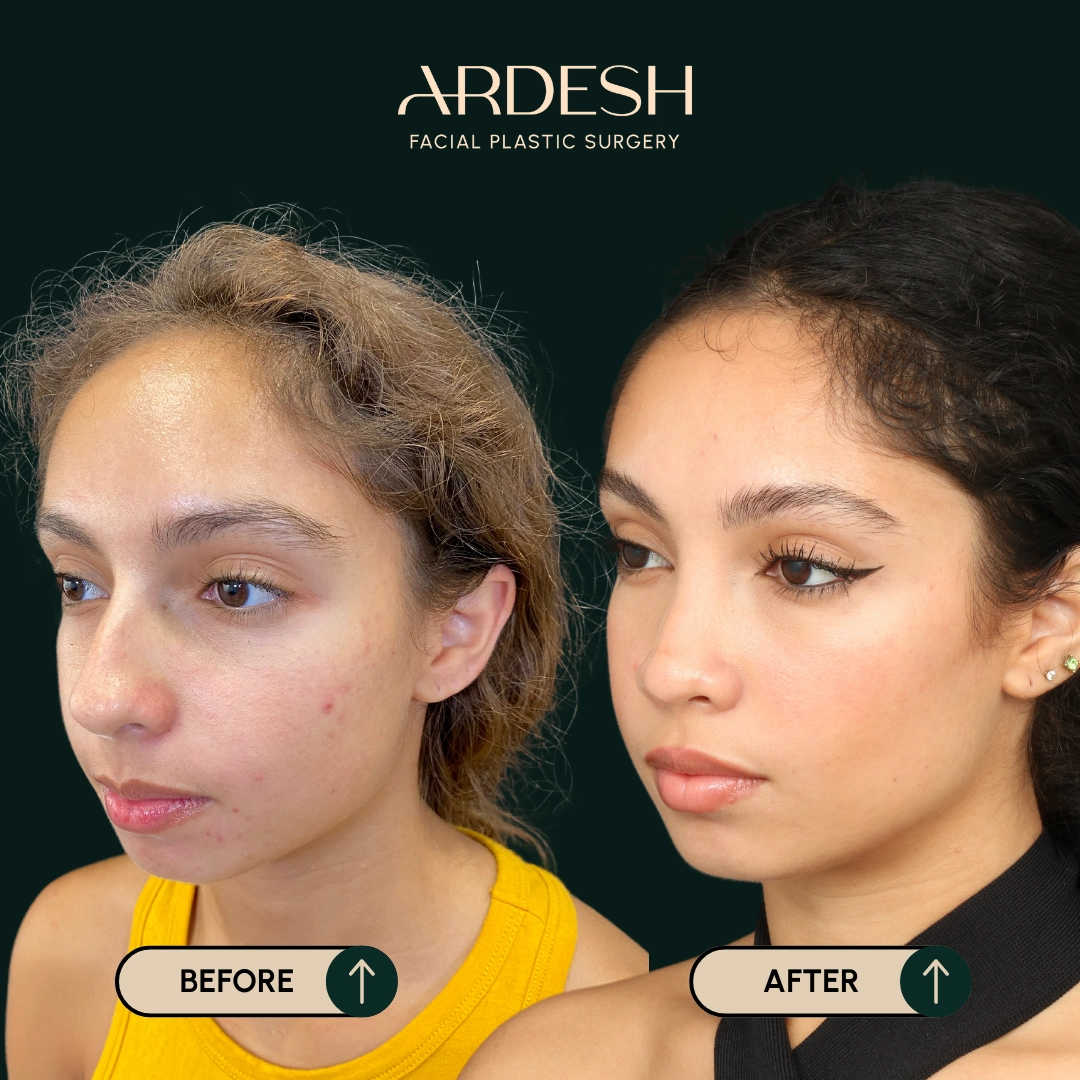
Two patients may want the same improvement to their nasal profile but require entirely different surgical techniques. One might benefit from preserving much of the existing nasal framework, while another needs more extensive structural reshaping.
This distinction sits at the centre of the discussion surrounding preservation and traditional rhinoplasty.
Both approaches aim to improve nasal appearance while maintaining or addressing functional concerns. However, the techniques used during rhinoplasty nose surgery can differ considerably.
Understanding these differences helps patients make informed decisions without assuming that newer surgical methods automatically produce better results.
About Dr. Ardesh
Dr. Ardesh of Beauty Mark MD is a double board-certified facial plastic and reconstructive surgeon known for delivering thousands of refined, natural outcomes. With an academic background that includes teaching in head and neck surgery, ophthalmology, and dermatology at Loma Linda University, he later transitioned into private practice to focus on patient-centred care. His philosophy emphasises subtle enhancement rather than obvious alteration, earning him recognition as a leading plastic surgeon in Beverly Hills and Newport Beach.
Two Approaches, Different Surgical Philosophies
Preservation rhinoplasty and traditional rhinoplasty aren't competing procedures with one universally superior outcome.
They represent different ways of managing nasal anatomy.
Preservation Rhinoplasty: Working With Existing Structures
Preservation rhinoplasty aims to retain selected natural anatomical structures wherever appropriate.
Rather than routinely removing or reconstructing the nasal bridge, surgeons may use techniques that reposition the existing framework.
For suitable patients, this approach can maintain natural dorsal contours while addressing particular aesthetic concerns.
However, preservation doesn't mean that no tissue is altered or removed.
Traditional Rhinoplasty: Reshaping the Framework
Traditional rhinoplasty surgery generally involves modifying nasal bone and cartilage through techniques such as reduction, repositioning, grafting or reconstruction.
It provides flexibility when significant structural changes are necessary.
This may be particularly relevant for patients with complex nasal anatomy, substantial asymmetry or previous nasal surgery.
Neither approach eliminates the need for careful surgical planning.
How Do the Surgical Techniques Differ?
The most meaningful distinction concerns how the surgeon manages the nasal bridge and supporting structures.
Preservation techniques may involve:
- Maintaining selected natural cartilage and ligament attachments.
- Lowering the nasal dorsum using appropriately selected techniques.
- Preserving the existing dorsal aesthetic lines.
- Limiting certain reconstructive steps when anatomy permits.
Traditional techniques may involve:
- Removing or reshaping portions of bone and cartilage.
- Reconstructing the nasal bridge where necessary.
- Using cartilage grafts to strengthen or modify support.
- Correcting complex irregularities through direct structural changes.
Both approaches can be performed using open or closed surgical access, depending on the procedure.
For patients considering nose reshaping rhinoplasty, the surgical access method shouldn't be confused with the preservation or structural reshaping strategy.
Which Patients May Benefit From Preservation Rhinoplasty?
Preservation techniques can be appropriate when the existing nasal framework has favourable characteristics.
A surgeon may consider this approach for patients with:
- A dorsal hump suitable for preservation-based correction.
- Relatively symmetrical nasal bones.
- Adequate structural support.
- Nasal anatomy that allows predictable repositioning.
- A preference for maintaining existing dorsal contours.
These characteristics don't guarantee suitability.
For example, certain severe deviations or complex structural problems may be difficult to address using preservation techniques alone.
A detailed examination is necessary before recommending any form of rhinoplasty nose surgery.
When Might Traditional Rhinoplasty Be More Appropriate?
Traditional techniques remain important because not every nasal concern can be corrected by preserving the existing framework.
Patients with substantial asymmetry, previous trauma or complex cartilage deformities may require direct reconstruction.
Traditional rhinoplasty surgery may also be considered when:
- The nasal tip requires significant structural support.
- Previous surgery has altered normal anatomy.
- The bridge needs extensive reconstruction.
- Functional problems require targeted correction.
Importantly, traditional techniques can still preserve healthy structures where appropriate. Modern surgical planning frequently combines preservation principles with selective reconstruction.
The distinction isn't always absolute.
Does Preservation Rhinoplasty Offer Faster Recovery?
Preservation rhinoplasty is sometimes associated with reduced tissue disruption, potentially resulting in less swelling or bruising in selected cases.
However, recovery depends on the extent of surgery, individual healing and the techniques performed.
What Should Patients Expect?
Following either approach, patients may experience:
- Nasal swelling and temporary congestion.
- Bruising around the eyes.
- Mild discomfort or pressure.
- Temporary restrictions on strenuous activity.
- Gradual changes in nasal definition as swelling resolves.
Many patients resume routine activities within approximately one to two weeks, although individual recovery varies.
Final refinement can take 12 months or longer, particularly around the nasal tip.
Patients exploring nose reshaping rhinoplasty should avoid choosing a procedure solely because it promises a shorter recovery.
What About Long-Term Results?
Both techniques can produce natural-looking, lasting improvements when appropriately selected and performed.
Preservation rhinoplasty may help maintain existing dorsal contours, while traditional techniques provide greater flexibility for extensive structural correction.
Neither guarantees perfect symmetry, unrestricted breathing or freedom from revision surgery.
Successful outcomes depend on surgical judgement, anatomical suitability and realistic expectations.
Choosing the Right Rhinoplasty Approach
The best technique is the one that addresses your specific nasal anatomy and aesthetic goals without compromising essential structural support.
Whether preservation methods or traditional rhinoplasty surgery are more appropriate should be determined through an individual assessment.
At Dr. Ardesh Facial Plastic Surgery, Dr. Farhad Ardesh provides personalised consultations for patients considering rhinoplasty nose surgery. His facial plastic surgery expertise helps patients explore suitable treatment options based on their individual concerns and desired outcomes.
Frequently Asked Questions
1. Is preservation rhinoplasty less invasive?
It may preserve more existing anatomy in selected cases, but it remains a surgical procedure with risks and recovery requirements.
2. Can preservation rhinoplasty correct a crooked nose?
Certain deviations may be treatable, but significant asymmetry can require more extensive structural correction.
3. Which technique produces more natural-looking results?
Both can achieve natural-looking outcomes. Results depend more on appropriate technique selection and surgical execution than the procedure's name.
4. Is traditional rhinoplasty better for revision cases?
Traditional reconstructive techniques are often useful in complex revision cases, although suitability depends on the remaining anatomy and previous procedures.
5. Can preservation and traditional techniques be combined?
Yes. Surgeons may combine preservation principles with targeted structural modifications when necessary to achieve the intended aesthetic and functional outcome.
For further insight into treatment selection, explore why two rhinoplasty surgeons may recommend different treatments.