Most people don't notice neck ageing overnight.
It happens gradually. One day, your profile in a photograph looks slightly different. A video call catches your attention from an unfamiliar angle. Then, under bright bathroom lighting, you realise your jawline no longer appears as defined as it once did.
The immediate reaction is often uncertainty.
"Is this normal ageing?"
"Am I imagining it?"
"Do I need a neck lift, or is this something that skincare can improve?"
These are some of the most common questions patients ask during facial plastic surgery consultations.
The truth is that no mirror test can diagnose whether surgery is necessary. However, a careful self-evaluation can help identify anatomical changes that deserve professional assessment. A structured neck lift self assessment is not about deciding whether you need surgery on your own, it is about recognising whether your neck anatomy has changed in ways that warrant expert evaluation.
Here is a five-minute assessment that facial plastic surgeons often use as a starting point when discussing neck rejuvenation.
About Dr. Ardesh
Dr. Ardesh of Beauty Mark MD is a double board-certified facial plastic and reconstructive surgeon known for delivering thousands of refined, natural outcomes. With an academic background that includes teaching in head and neck surgery, ophthalmology, and dermatology at Loma Linda University, he later transitioned into private practice to focus on patient-centred care. His philosophy emphasises subtle enhancement rather than obvious alteration, earning him recognition as a leading plastic surgeon in Beverly Hills and Newport Beach.
1. Evaluate Your Jawline Definition
Stand in front of a well-lit mirror with your head in a natural, relaxed position.
Avoid lifting your chin.
Instead, look at the transition between your jaw and neck.
A youthful neck typically demonstrates a clear separation between these two regions.
Ask yourself:
- Has the jawline become less distinct?
- Does the lower face blend into the neck?
- Has the definition beneath the chin gradually disappeared?
Loss of jawline definition often reflects structural tissue descent rather than changes in body weight alone.
This is one of the earliest signs patients notice before considering whether they may eventually need a neck lift.
2. Examine Your Neck From the Side
Turn approximately 90 degrees toward the mirror.
The side profile reveals anatomical details that are difficult to appreciate from the front.
Pay attention to:
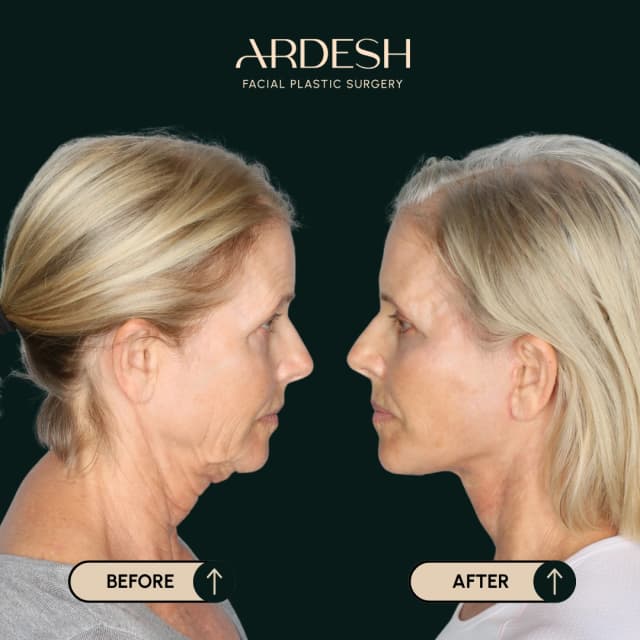
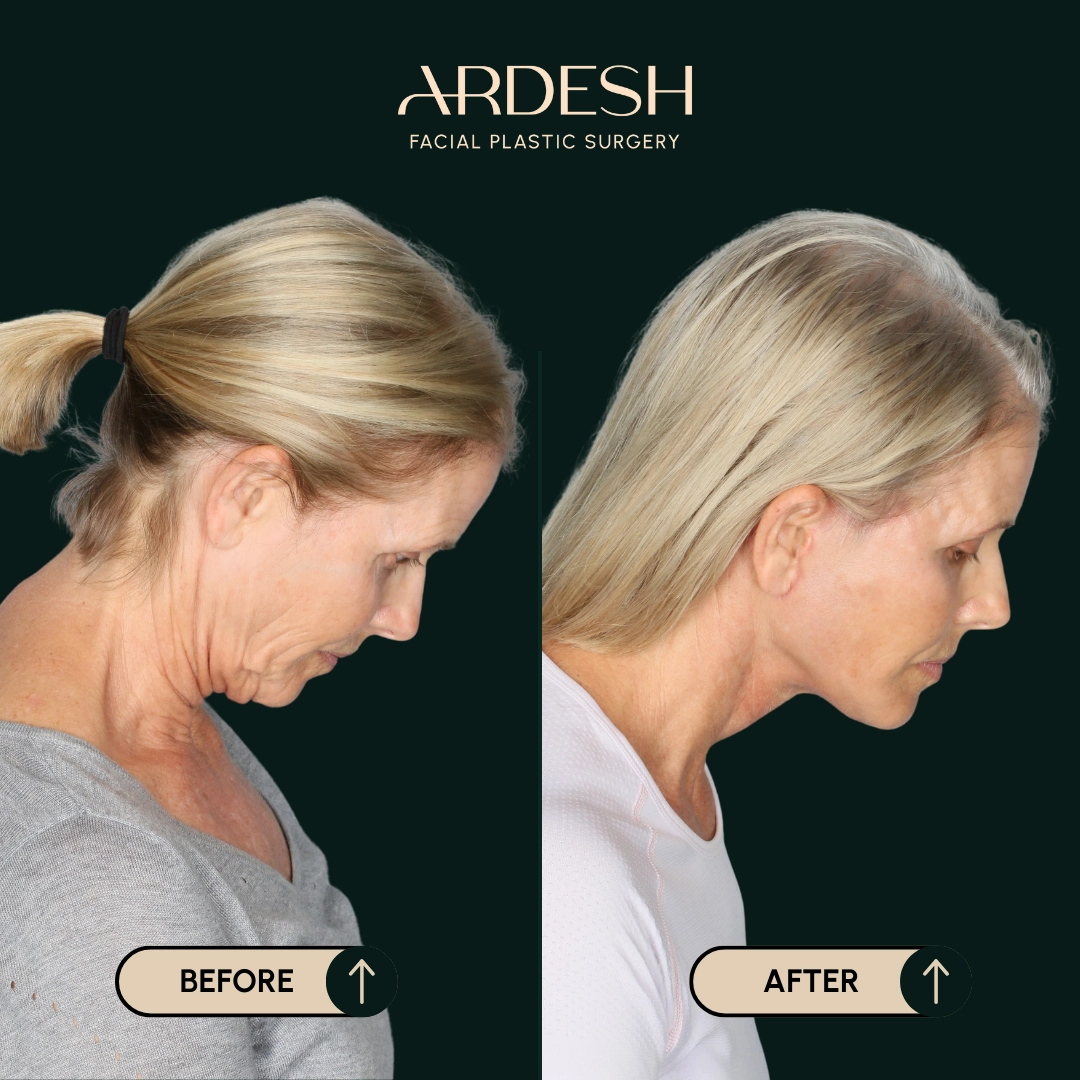
- Skin laxity beneath the chin
- Fullness along the upper neck
- The angle between the chin and neck
- Excess skin extending toward the collarbone
Facial plastic surgeons refer to this contour as the cervicomental angle.
As tissues age, this angle gradually becomes less defined due to skin redundancy, muscle laxity, or soft tissue descent.
Changes in profile often become apparent years before patients recognise them from the front.
3. Test Skin Elasticity, Carefully
Using two fingers, gently lift a small amount of skin beneath the jaw.
Release it immediately.
Healthy skin should return smoothly without prolonged folding or wrinkling.
Persistent laxity may indicate reduced collagen support.
It is important to understand that this simple observation cannot determine whether surgery is required.
Skin behaviour represents only one layer of neck anatomy.
Muscles, connective tissues, facial proportions, and underlying support structures all contribute to neck ageing.
For this reason, neck lift self assessment should never rely on skin quality alone.
4. Observe the Neck During Movement
Most people evaluate themselves while remaining perfectly still.
However, dynamic movement often reveals changes that static photographs cannot.
Smile naturally.
Swallow once.
Speak for several seconds.
Watch for:
- Vertical muscle bands
- Skin folding
- Irregular contour changes
- Excess movement beneath the jaw
These findings may reflect changes involving the platysma muscle, a broad superficial muscle responsible for much of the neck's contour.
Age-related separation of this muscle is one of the most common structural contributors to visible neck ageing.
5. Compare Current Photos With Older Images
Perhaps the most valuable part of this assessment involves comparison rather than observation.
Choose photographs taken:
- Five years ago
- Ten years ago
- In similar lighting
- At similar camera angles
Rather than focusing on wrinkles, evaluate:
- Jawline continuity
- Neck definition
- Chin projection
- Skin contour beneath the jaw
Because ageing occurs gradually, many patients adapt to subtle changes over time.
Historical photographs often reveal anatomical progression that is difficult to appreciate day by day.
What Your Mirror Cannot Tell You
This assessment provides useful observations, but it cannot identify the anatomical cause.
Several different conditions may produce similar visual changes.
For example:
- Loose skin
- Platysma muscle separation
- Deep cervical fat
- Reduced chin projection
- Volume loss in the lower face
- Genetic neck anatomy
Although these conditions may appear similar in the mirror, they require entirely different treatment approaches.
This is why experienced facial plastic surgeons begin with anatomical diagnosis rather than recommending procedures immediately.
So, Do I Need a Neck Lift?
This question cannot be answered by photographs, online quizzes, or mirror tests alone.
Instead, it depends on identifying which anatomical structures have changed.
Patients asking "Do I need a neck lift?" generally fall into three broad categories.
Early Structural Changes
Patients may notice mild loss of jawline definition while maintaining good skin quality.
These individuals may simply benefit from observation or conservative treatment planning.
Moderate Anatomical Ageing
Here, skin laxity, early platysmal changes, and contour irregularities become more visible.
Professional assessment becomes increasingly valuable in determining appropriate management.
Advanced Neck Ageing
Significant skin redundancy, muscle banding, and tissue descent frequently require surgical correction because superficial treatments cannot restore deeper structural anatomy.
The key point is that appearance alone does not determine candidacy.
The underlying anatomy does.
Why Neck Lift Plastic Surgery Is Based on Anatomy, Not Age
There is no specific age at which someone becomes a candidate for neck lift plastic surgery.
Two patients of the same age may have completely different anatomical findings.
Similarly, younger patients with inherited neck laxity may benefit from evaluation long before significant facial ageing develops.
A comprehensive consultation considers:
- Skin elasticity
- Muscle integrity
- Chin support
- Facial proportions
- Connective tissue quality
- Overall facial harmony
These factors allow treatment recommendations to be individualised rather than based on chronological age.
Many people who realize they may benefit from a neck lift immediately worry that surgery will dramatically alter their appearance. In reality, the goal is usually to restore definition rather than change facial identity. You can learn more in Does a Neck Lift Change Your Face?, where we explain what actually changes after surgery and what remains naturally yours.
Precision Matters More Than the Procedure
Modern facial plastic surgery is no longer about simply tightening loose skin.
Successful neck rejuvenation restores balance between multiple anatomical layers while maintaining a natural appearance.
Overcorrection, excessive tension, or failure to address deeper structures can compromise long-term results.
This is why specialist facial plastic surgery focuses on restoring youthful contour rather than creating an artificial appearance.
Every neck presents differently, and every treatment plan should reflect that individuality.
When a Professional Assessment Becomes the Most Valuable Step
A mirror can highlight changes.
It cannot explain why they have occurred.
If your self-assessment reveals progressive loss of jawline definition, persistent neck laxity, or visible structural changes, the next step is not guessing, it is obtaining an expert anatomical evaluation.
At Dr. Ardesh Facial Plastic Surgery consultations are built around detailed facial analysis, careful examination of skin, muscle, and facial proportions, and personalized treatment recommendations based on each patient's unique anatomy.
If you are asking yourself, "Do I need a neck lift?", considering neck lift plastic surgery, or exploring options for neck rejuvenation in Los Angeles, scheduling a consultation with Dr. Ardesh provides the opportunity to understand the anatomical cause of your concerns and discuss treatment options designed to achieve refined, natural-looking results.
For those researching an affordable neck lift in Los Angeles, the consultation is the appropriate first step in determining which approach best aligns with your anatomy and aesthetic goals.
Frequently Asked Questions
1. Can a mirror test tell me if I need a neck lift?
No. A mirror test can help you recognise visible changes, but only a comprehensive facial examination can determine whether those changes are caused by skin laxity, muscle ageing, fat distribution, or other anatomical factors.
2. What is a neck lift self assessment?
A neck lift self assessment is a structured way of observing changes in your neck contour, jawline, skin quality, and profile before seeking professional evaluation. It is not a substitute for medical diagnosis.
3. Do I need a neck lift if I only have mild neck sagging?
Not necessarily. Mild changes may simply require monitoring or conservative management. The most appropriate treatment depends on your underlying anatomy rather than the visible amount of sagging alone.
4. What does neck lift plastic surgery correct?
Neck lift plastic surgery addresses structural causes of neck ageing, including excess skin, platysma muscle laxity, and loss of jawline definition, to restore a smoother and more balanced neck contour.
5. Why should I consult a facial plastic surgeon instead of relying on online assessments?
Online assessments cannot evaluate muscle integrity, facial proportions, connective tissue quality, or individual anatomy. A facial plastic surgeon performs a detailed examination to recommend treatment based on your specific structural findings rather than assumptions.