People have been getting botox treatment for decades without fully understanding what's happening beneath the surface. That's not a criticism.
Most of us don't know how ibuprofen works either, and we take it anyway. But Botox is injected into your face, which tends to make people want a bit more detail before they commit.
So here's the actual mechanism. No fluff. No vague reassurances about it being "safe and effective."
The biology of what happens when botulinum toxin enters muscle tissue is genuinely interesting and understanding it changes how you think about results, timing, and why some treatments land better than others.
About Dr. Ardesh
Dr. Ardesh of Beauty Mark MD is a double board-certified facial plastic and reconstructive surgeon known for delivering thousands of refined, natural outcomes. With an academic background that includes teaching in head and neck surgery, ophthalmology, and dermatology at Loma Linda University, he later transitioned into private practice to focus on patient-centred care. His philosophy emphasises subtle enhancement rather than obvious alteration, earning him recognition as a leading plastic surgeon in Beverly Hills and Newport Beach.
It starts with a bacterium most people have heard of in a different context
Botulinum toxin is produced by Clostridium botulinum - the bacterium behind botulism. The toxin itself is extraordinarily potent in its natural form. In clinical use, it's purified, diluted, and injected in quantities so small they're measured in units rather than milligrams.
The leap from "causes botulism" to "cosmetic injection" sounds jarring until you understand that the therapeutic application targets a completely different process at a completely different scale. Botulism is systemic toxin exposure. Botox is localized, controlled, temporary muscle signal interruption. Same molecule. Entirely different context.
There are several formulations on the market - Botox (onabotulinumtoxinA), Dysport, Xeomin, Jeuveau. The mechanism is the same across all of them. The differences are in protein composition, unit equivalence, and diffusion behavior. For practical purposes, the biology covered here applies to all of them.
The neuromuscular junction: where the action happens
To understand what Botox does, you need a rough picture of how a muscle contracts in the first place.
When your brain sends a signal to move a muscle - squinting, frowning, raising your eyebrows - that signal travels down a motor nerve to a junction point where the nerve meets the muscle fiber. That junction is called the neuromuscular junction.
At that junction, the nerve terminal releases a chemical messenger called acetylcholine. Acetylcholine crosses the tiny gap between nerve and muscle, binds to receptors on the muscle fiber, and triggers contraction. The muscle moves. You express something. A line forms in the skin above it.
Do that ten thousand times over ten years and the line stops going away when the face relaxes. That's a dynamic wrinkle becoming a static one.
Botox intervenes at the acetylcholine step.
What the toxin actually does at the molecular level
Here's where it gets specific.
Botulinum toxin is a two-part protein. One part binds to the nerve terminal at the neuromuscular junction. The other part - the active component - gets pulled inside the nerve cell. Once inside, it targets a protein called SNAP-25, which is part of the machinery the nerve uses to release acetylcholine.
SNAP-25 is essentially a docking protein. It helps the vesicles carrying acetylcholine fuse with the nerve terminal membrane so the neurotransmitter can be released into the junction. Botulinum toxin cleaves SNAP-25. Cut it. The vesicles can no longer fuse. Acetylcholine stays locked inside the nerve terminal.
No acetylcholine release. No signal reaching the muscle. No contraction.
The muscle doesn't die. It doesn't atrophy in any lasting way from a single treatment cycle. It simply stops receiving the instruction to contract for as long as the toxin remains active. That window is typically 3 to 4 months for most patients, longer with repeated treatments over time.
Why results take days, not hours
This surprises people. You get a botox treatment on Thursday afternoon and expect to see something by Friday morning. Usually that's not how it goes.
The binding process is fast - the toxin attaches to nerve terminals within hours of injection. But the intracellular process takes longer. The toxin needs to be internalized by the nerve cell, travel through the cell, and cleave enough SNAP-25 to meaningfully reduce acetylcholine release. That sequence takes 2 to 5 days for initial effects to appear, with full results visible at 10 to 14 days.
This timeline is biological, not a function of the injector's technique or the formulation used. Patients who check the mirror the next morning and see no change aren't looking at a failed treatment. They're looking at a treatment that hasn't finished working yet.
The flip side of this: the 2-week mark is the honest evaluation point. Not day two. Not day five. Two weeks post-injection is when you're seeing what the treatment actually produced.
The diffusion question - and why placement precision matters
Botulinum toxin doesn't stay exactly where it's injected. It diffuses outward from the injection site. The extent of that diffusion depends on the formulation, the volume injected, the injection depth, and the injector's technique.
This diffusion is a feature, not a bug, when managed correctly. It allows a small number of well-placed injections to affect a broader area of muscle tissue without requiring a separate injection at every point. When managed poorly - wrong depth, wrong volume, wrong site - diffusion carries toxin into adjacent muscles that weren't the target.
The classic example: botox treatment for forehead lines that drifts too low and partially affects the levator palpebrae superioris, the muscle that holds the upper eyelid open. Result: eyelid ptosis. Drooping that resolves when the treatment wears off but creates an unwanted appearance in the interim.
This is rare in experienced hands. It's more common when treatment is done by someone operating from a protocol rather than a detailed understanding of facial anatomy. The forehead is a particularly unforgiving area because the muscles involved interact with brow position and eyelid opening in ways that require specific anatomical knowledge to navigate safely.
How repeated treatments affect the muscle over time
There's a question that comes up consistently among patients considering long-term Botox use: does the muscle permanently weaken?
The honest answer is: somewhat, and that's often the point.
With repeated botox treatment cycles over several years, muscles that are consistently prevented from contracting do gradually reduce in size and strength. This is a normal physiological response to reduced use - the same principle that causes any underused muscle to become less prominent over time.
In practice, this means:
- Patients who have had regular treatment for several years often find their results last longer per session
- The treatment intervals can sometimes extend from 3 months to 4 or 5 months without loss of effect
- The dose required per session may decrease over time as the muscle becomes less active
This progression is generally positive for cosmetic patients. The gradual reduction in muscle activity is part of why long-term Botox users often look less lined than their age peers who haven't had treatment - the cumulative effect of reduced muscle movement over years, not just the current treatment cycle.
What it doesn't do: cause permanent paralysis, change facial structure in any lasting architectural way, or produce unnatural results from long-term use alone. Those outcomes are a function of overtreatment, not regular appropriate treatment.
What this means for where Botox actually works
The mechanism - blocking neuromuscular transmission - tells you directly what Botox can and cannot address.
It works on:
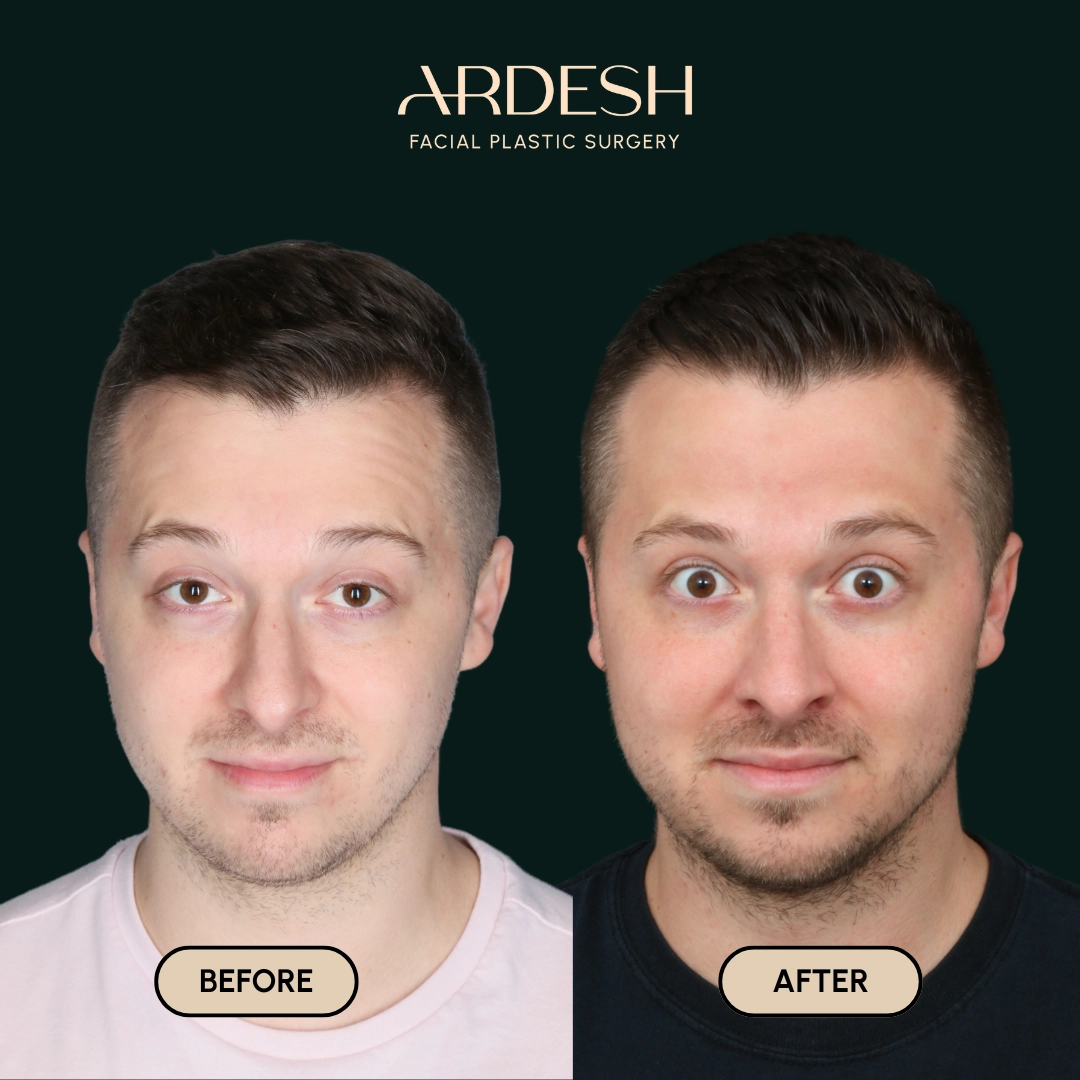
- Lines caused by repeated muscle movement: forehead lines, glabellar lines between the brows, crow's feet at the outer eye corners
- Brow position adjustment through targeted relaxation of depressor muscles
- Lip flip and upper lip line treatment
- Jaw slimming through masseter reduction
- Neck banding from platysmal muscle activity
- Hyperhidrosis (excessive sweating) by blocking acetylcholine in sweat glands, which use the same signaling pathway
It doesn't work on:
- Static lines that exist at rest and aren't driven by muscle movement - those are volume and structural issues that filler or surgery addresses
- Skin texture, pore size, or pigmentation concerns
- Any structural facial change that isn't driven by muscle activity
The treatment decision should follow from this understanding. Botox placed in an area where the line isn't muscle-driven produces no result. Not because the injection was poor. Because the mechanism doesn't apply to that problem.
A note on what "units" actually means
Botox is dosed in units. A glabellar treatment might use 20 units. Crow's feet 10 to 15 per side. A forehead 10 to 20 depending on the individual's muscle mass and activity.
Units aren't a measure of volume. They're a measure of biological activity - specifically, the amount of toxin required to produce a defined effect in a standardized assay. Different brands use different unit scales (Dysport units and Botox units aren't equivalent on a 1:1 basis), which is why unit counts aren't directly comparable across formulations.
What matters practically: the appropriate dose for any individual depends on muscle mass, the strength of habitual muscle activity, the area being treated, and the desired outcome. There's no universal right answer. The injector adjusts based on those variables, which is part of why the consultation before a botox treatment appointment is more than a formality.
Closing thought
Dr. Farhad Ardesh is a dual-board certified facial plastic surgeon whose work centers on results that look natural and age-appropriate rather than treated. For patients who want Botox administered by someone with deep anatomical knowledge of the face rather than a protocol, his Beverly Hills and Newport Beach consultations are worth booking.