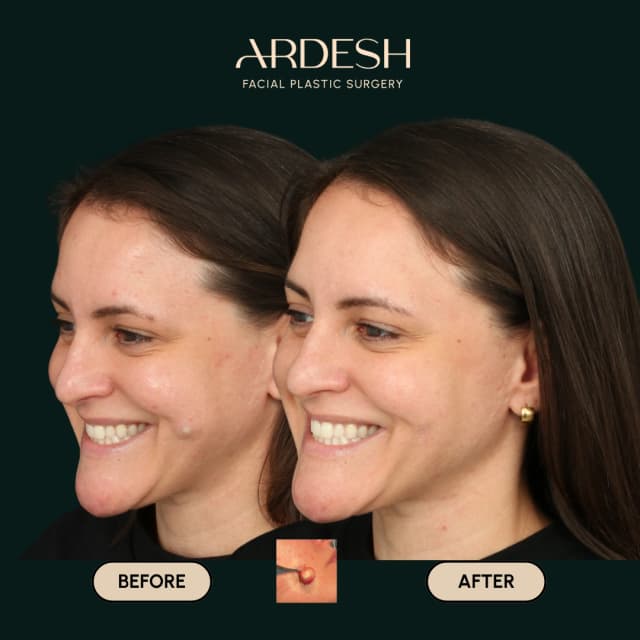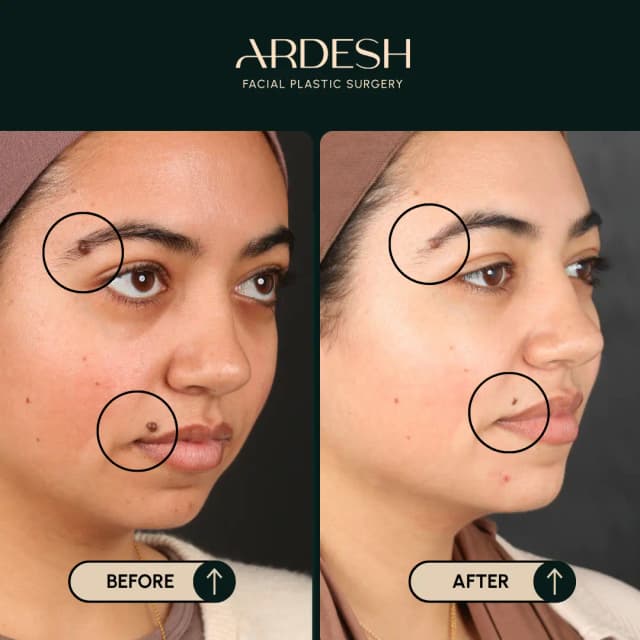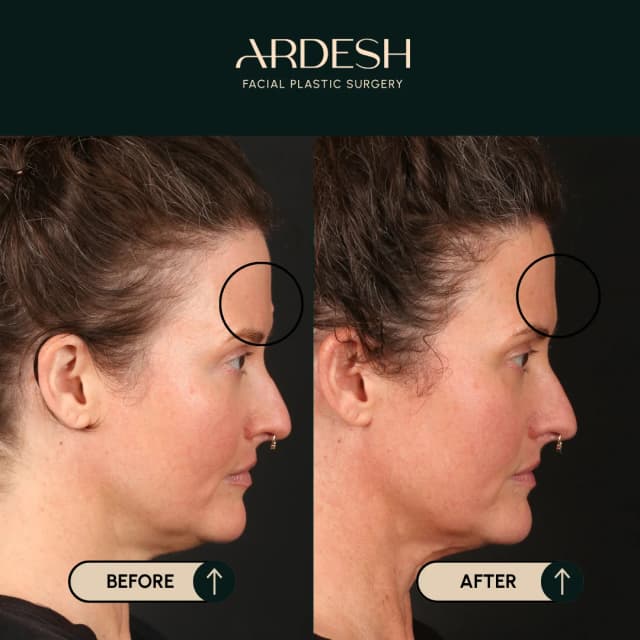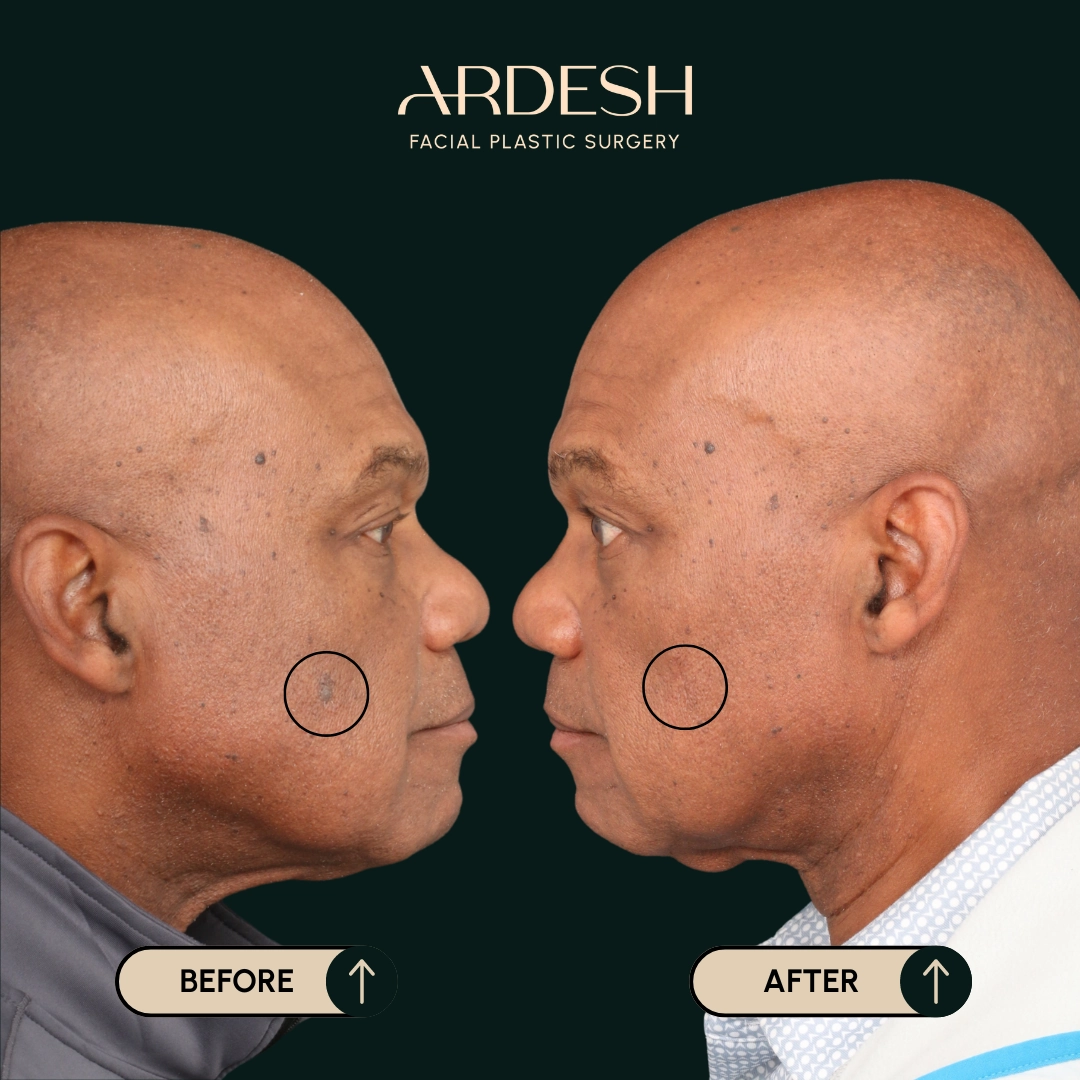
The short answer: it depends on the mole. Laser works well for flat, superficial spots. Surgery handles deeper, raised, or diagnostically uncertain lesions. Most people looking for mole removal around Glendale don't need to pick blindly - a qualified facial plastic surgeon can tell you in one consultation which method fits your specific case.
That said, knowing the difference before you walk in changes the quality of that conversation.
About Dr. Ardesh
Dr. Ardesh of Beauty Mark MD is a double board-certified facial plastic and reconstructive surgeon known for delivering thousands of refined, natural outcomes. With an academic background that includes teaching in head and neck surgery, ophthalmology, and dermatology at Loma Linda University, he later transitioned into private practice to focus on patient-centred care. His philosophy emphasises subtle enhancement rather than obvious alteration, earning him recognition as a leading plastic surgeon in Beverly Hills and Newport Beach.
The two methods, without the sales pitch
People often come in thinking laser is the "modern" option and surgery is the "old school" one. That framing isn't useful. Both techniques have specific jobs. Neither is categorically better.
What laser removal actually does
Laser targets pigmented cells using concentrated light energy. The beam breaks down melanin-rich tissue layer by layer. No incision. No stitches. The body processes the destroyed cells over the following weeks.
It works best on:
- Flat, discolored spots (like seborrheic keratoses or small junctional nevi)
- Moles sitting at or near the surface of the skin
- Areas where avoiding a visible scar is a top priority
- Patients with lighter to medium skin tones, where pigment contrast is sharper
What it doesn't do well: remove deep dermal moles in one session, or give you a tissue sample for biopsy. If a mole has any irregular border, color variation, or history of change, laser isn't the starting point. You need a pathology report first.
What surgical excision actually does
Surgical removal physically cuts the mole out. The surgeon removes the full lesion plus a small margin of surrounding tissue, then closes the wound. That removed tissue goes to a lab.
It works best on:
- Raised moles, especially compound or intradermal nevi
- Moles with any atypical features
- Lesions where pathological confirmation matters
- Patients who want permanent, single-session removal without relying on the skin's healing response
The tradeoff is a scar. With skilled technique, that scar becomes nearly invisible. But it doesn't disappear entirely, and managing expectations here matters.
The factor most people skip: the biopsy question
Here's what gets under-discussed in most online comparisons of these two methods. Lasers destroy tissue. Surgery preserves it.
If a mole ever raises the question - even a small one - of whether it needs pathological examination, laser takes that option off the table. You can't send burned tissue to a lab.
Dermatologists and surgeons who work in this area generally agree: any mole that looks atypical, has changed recently, or falls in the "I'm not 100% sure" category should be excised surgically so the sample can be reviewed. That's not overcaution. That's the standard of care.
For cosmetic moles where there's no diagnostic concern, laser is a reasonable conversation. But the conversation has to happen with a physician who can actually look at the lesion first.
What recovery looks like for each method
Both procedures are outpatient. Neither requires general anesthesia. But recovery differs, and that difference matters if you're planning around work or social events.
After laser removal:
- Treated area turns darker before it fades - typically 1 to 2 weeks
- No stitches, no wound care beyond keeping the area clean and protected
- Sun avoidance is non-negotiable during healing - UV exposure on freshly treated skin leads to hyperpigmentation
- Multiple sessions sometimes needed for deeper pigmented lesions
After surgical excision:
- Small wound closed with sutures, removed within 5 to 7 days depending on location
- Mild swelling and tenderness for a few days
- A fine scar forms, which continues to fade over 6 to 12 months
- Activity restrictions are minimal - most patients return to normal routines within days
Neither recovery is particularly difficult. For most people choosing between these methods, the main variable isn't recovery - it's the long-term appearance result and whether a biopsy is clinically appropriate.
Location on the face changes the calculation
This part matters more than people expect.
Moles on the face - especially around the nose, lips, eyelids, and ears - sit in territory where both the surgical access and the cosmetic stakes are higher. A general practitioner or dermatologist removing a mole on the forearm is a different situation from a facial plastic surgeon removing one at the nasal tip.
The facial anatomy is more complex. The skin is thinner. The healing response is different. And for patients coming in specifically because they want a natural-looking result with minimal visible change, the surgeon's experience with facial tissue directly affects the outcome.
Patients researching mole removal around Glendale should ask specifically whether the provider specializes in the face or handles general dermatology. That distinction is worth asking about.
When laser is clearly the wrong call
A few situations where laser removal doesn't belong in the conversation:
- Any mole showing the ABCDE warning signs (asymmetry, irregular border, multiple colors, diameter over 6mm, evolution/change over time). Surgical excision and pathology review first.
- History of atypical moles or melanoma in the family. Baseline monitoring and biopsy protocols take precedence.
- Raised, dome-shaped lesions. The laser doesn't penetrate deep enough. You'd likely need multiple sessions, incomplete removal, and a higher chance of recurrence.
- Darker skin tones. Post-inflammatory hyperpigmentation is a real risk with certain laser wavelengths on melanin-rich skin. The surgeon needs to assess this explicitly.
None of this means lasers are dangerous. It means the laser is specific. And specificity requires a proper evaluation.
The honest version of the cost conversation
Both procedures are typically classified as cosmetic, meaning insurance rarely covers them. Laser tends to run lower per session, but may require 2 to 3 sessions for complete removal. Surgical excision costs more upfront but usually resolves the lesion in one appointment.
When you factor in time, follow-up visits, and the possibility of retreatment, the total cost difference narrows considerably. For moles where surgery is the right clinical call, choosing a laser to save money often costs more in the end - financially and in terms of results.
What the right process actually looks like
A good process for mole removal isn't complicated. It's just not always followed.
- Initial consultation with a physician - not a medspa intake coordinator - who examines the mole and assesses whether it needs pathological review
- Method recommendation based on the specific lesion, not on what the practice's most popular service happens to be
- Clear explanation of expected healing, realistic scar outcomes, and what the result will look like at 6 months - not just at discharge
- A single point of accountability - the surgeon who evaluates you should be the one performing the procedure
That last point is more important than it sounds. When patients pursuing mole removal around Glendale or nearby areas get evaluated by one provider and treated by a different technician, continuity breaks down. The result is rarely as precise.
Why the surgeon's background in facial work matters here
Mole removal sounds routine. On the face, it isn’t.
The difference between a result that blends into your skin and one that draws attention often comes down to technique. How the tissue is removed. How the wound is closed. How tension is managed across delicate facial areas. And most importantly, whether the surgeon understands how different parts of the face heal.
This is where methods like shave removal and surgical excision consistently outperform laser in real-world outcomes.
Unlike laser, these techniques allow for:
- Complete removal of the mole in a controlled manner
- Precise shaping of the skin surface for smoother healing
- The option for biopsy when there’s any diagnostic uncertainty
- More predictable, single-session results
Laser may seem appealing because it avoids stitches. But on the face, where precision matters more than convenience, it often falls short for anything beyond very superficial lesions. In many cases, it leads to incomplete removal, repeat sessions, or pigment changes that are harder to correct later.
Shave and excision, when performed by a specialist in facial procedures, offer something more valuable: control. And control is what leads to results that look natural over time.
Dr. Farhad Ardesh has performed multiple procedures with a focused approach to facial aesthetics and scar minimisation. His practice, built around the Beauty Mark MD approach, is centred on one outcome: removal that integrates seamlessly with the surrounding skin.
Patients travel across California not just for removal, but for results that don’t look like a procedure was ever done.
For anyone weighing laser versus surgical options, the more useful place to start isn’t the method. It’s the surgeon. The method follows the evaluation. The outcome follows the hands performing it.
Consultations with Dr. Ardesh are available in Beverly Hills and Newport Beach. If you’re considering mole removal around Glendale, it’s worth having that conversation first, especially when the goal isn’t just removal, but how your skin looks months after it heals.