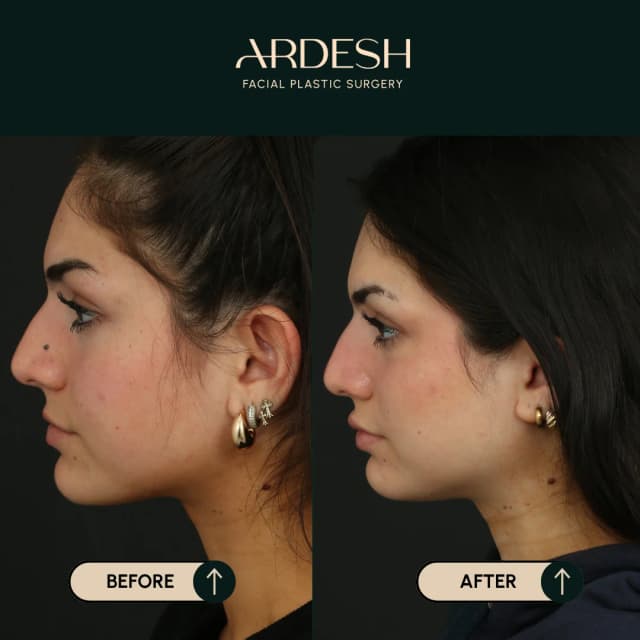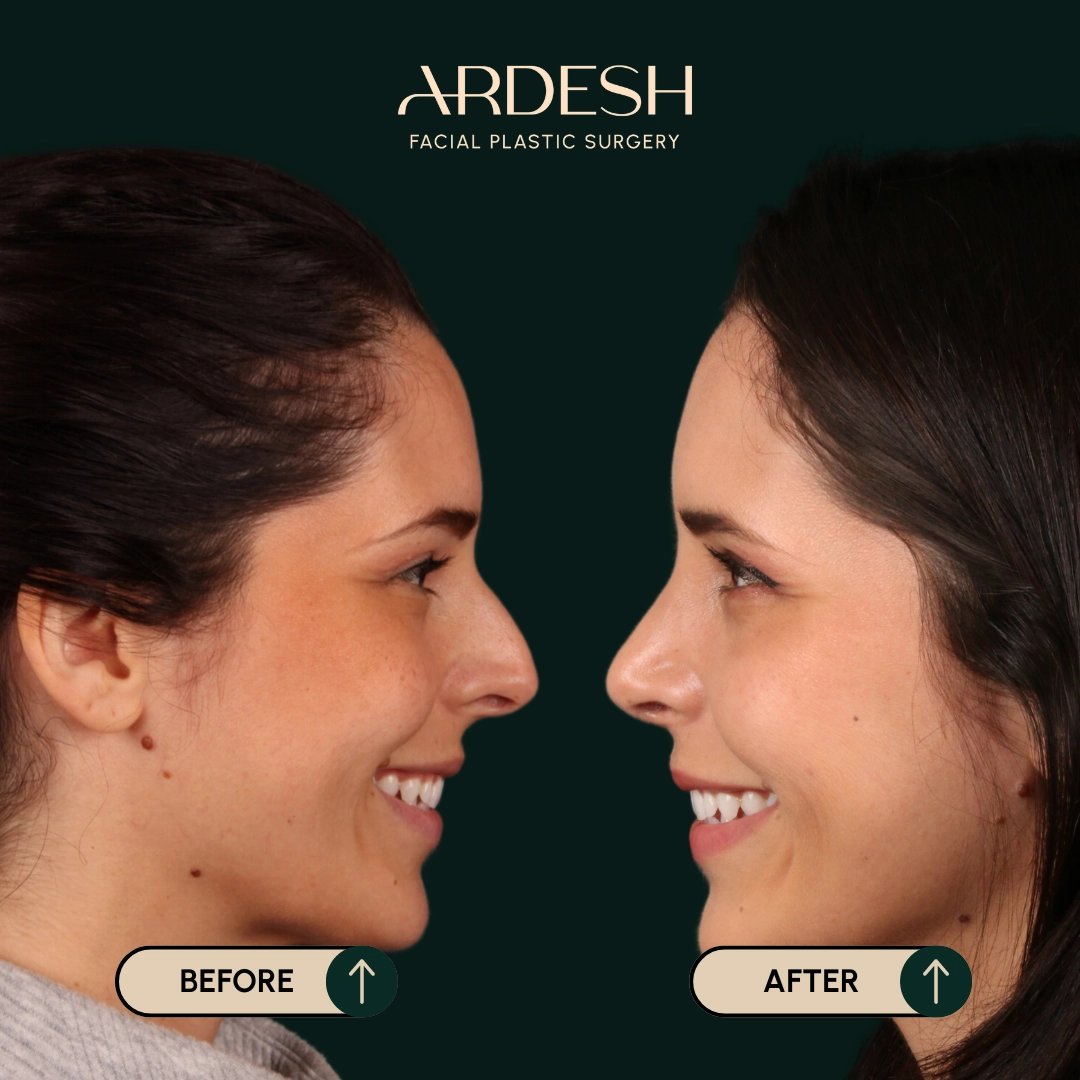
People search for the “right” Rhinoplasty age constantly. And age is an important consideration in rhinoplasty, not because it determines candidacy on its own, but because it influences anatomy, tissue quality, healing patterns, and long-term surgical planning. While rhinoplasty can be successfully performed across a wide range of adult ages, the characteristics of the nose and surrounding facial structures continue to change throughout life.
Factors such as skin elasticity, cartilage strength, nasal support, airway function, and healing capacity may all affect how surgery is planned and how results evolve over time. For this reason, a rhinoplasty procedure performed in a healthy patient in their twenties may involve different considerations than one performed in a patient in their forties or beyond.
Understanding how age influences both surgical decision-making and recovery can help patients develop realistic expectations and make more informed treatment choices.
About Dr. Ardesh
Dr. Ardesh of Beauty Mark MD is a double board-certified facial plastic and reconstructive surgeon known for delivering thousands of refined, natural outcomes. With an academic background that includes teaching in head and neck surgery, ophthalmology, and dermatology at Loma Linda University, he later transitioned into private practice to focus on patient-centred care. His philosophy emphasises subtle enhancement rather than obvious alteration, earning him recognition as a leading plastic surgeon in Beverly Hills and Newport Beach.
The nose keeps aging with the rest of the face
A lot of people imagine the nose as fixed structure once puberty ends.
It is not.
Over time:
- cartilage weakens
- skin elasticity changes
- nasal tips may droop
- airway support can narrow
- asymmetries become more noticeable
- previous injuries start showing up more clearly
This is why surgeons evaluate a 25-year-old and a 45-year-old differently, even when both patients technically want “the same thing.”
The surgical plan has to account for what the nose will continue doing years after surgery too.
What surgeons typically see in younger rhinoplasty patients
Patients in their 20s often come in focused on appearance first.
Common concerns include:
- dorsal humps
- crooked bridges
- tip shape
- asymmetry in photos
- side-profile dissatisfaction
- sports-related injuries
But something has shifted over the last decade.
Younger patients used to request dramatic changes more frequently. Now, especially in Los Angeles and Beverly Hills, many actively want restraint. They bring in photos and say things like:
- “I still want to look like myself.”
- “I don’t want a tiny nose.”
- “I want subtle improvement.”
- “I don’t want people to immediately know I had surgery.”
That shift probably reflects backlash against the overly sculpted cosmetic trends that dominated social media for years.
Patients increasingly want refinement that ages naturally.
Older patients often focus on structure and balance
Patients in their 40s usually describe the issue differently.
The concern is often less about chasing perfection and more about correcting something that has bothered them for decades or has changed with age.
Common concerns include:
- drooping nasal tip
- heavier appearance
- worsening asymmetry
- breathing changes
- old trauma becoming more visible
- facial imbalance during aging
Some also notice subtle airway issues developing over time.
According to research published in Facial Plastic Surgery, age-related weakening of nasal tip support and internal valve narrowing can contribute to progressive breathing complaints in some adults.
That becomes relevant when discussing the best age for rhinoplasty because older patients are often balancing both cosmetic and functional goals simultaneously.
For patients experiencing nasal obstruction, chronic congestion, or mouth breathing alongside cosmetic concerns, functional assessment may be an important part of surgical planning. Our article, "I Breathe Through My Mouth Because of My Nose - Can Rhinoplasty Actually Fix That?", explores how structural nasal issues can contribute to breathing difficulties and when rhinoplasty may help.
Healing changes more than people expect
This is one of the most overlooked parts of the conversation.
At 25, healing is usually:
- faster
- more predictable
- supported by stronger collagen production
- associated with tighter skin contraction
At 45, healing still occurs well in healthy patients, but certain patterns shift:
- swelling may linger longer
- skin may not contract as tightly
- thinner skin can reveal irregularities more easily
- cartilage support becomes more important
That does not mean results become poor with age.
Actually, many surgeons will tell you older patients often have smoother recoveries emotionally because expectations tend to be more realistic and patient decision-making is less impulsive.
Still, age changes surgical planning.
Recovery expectations may also vary based on age, skin characteristics, and individual healing patterns. Patients interested in understanding the typical healing process can read "What Nobody Tells You About Rhinoplasty Recovery - A Week-by-Week Breakdown" for a detailed overview of recovery milestones and common postoperative experiences.
How age affects rhinoplasty planning
| Age Range | Common Surgical Considerations |
|---|---|
| Early 20s | Strong cartilage, tighter skin, cosmetic-focused goals |
| Late 20s to 30s | Stable anatomy, balanced cosmetic and functional concerns |
| 40s and beyond | Structural support, airway stability, skin elasticity, and natural aging integration |
The biggest misconception around Rhinoplasty age is assuming younger automatically means better.
A poorly planned rhinoplasty at 23 can age worse than a carefully structured rhinoplasty at 48.
Long-term support matters.
Emotional maturity matters too
This part rarely gets discussed honestly online.
Patients at different ages tend to approach surgery psychologically in different ways.
Younger patients sometimes focus heavily on:
- selfies
- symmetry
- social comparison
- online beauty standards
- immediate visual change
Older patients usually focus more on:
- confidence
- facial harmony
- subtlety
- aging naturally
- looking less tired or heavy
Neither perspective is wrong.
But surgeons often look carefully at emotional readiness, especially with younger patients seeking major appearance changes. Unrealistic expectations create dissatisfaction at any age.
Patients searching for the best age for rhinoplasty sometimes expect a hard number. In reality, emotional maturity matters almost as much as anatomy.
Older patients are often better candidates than they assume
One thing worth saying directly:
being over 40 does not automatically make someone a “late” rhinoplasty patient.
Healthy patients in their 40s, 50s, and sometimes beyond may still be excellent candidates if:
- skin quality remains reasonable
- medical conditions are controlled
- healing capacity is good
- expectations are realistic
In fact, older patients frequently request the kinds of natural-looking refinements that tend to age best over time anyway.
The goal often becomes:
“I want to look refreshed, balanced, and still recognizable.”
That is usually a healthier target than dramatic transformation.
Risks and limitations should still be discussed honestly
This is surgery. Age does not remove that reality.
Potential risks include:
- prolonged swelling
- scar tissue formation
- asymmetry
- breathing changes
- delayed healing
- revision surgery
- dissatisfaction with subtle outcomes
Older patients may also face slightly slower tissue recovery depending on skin quality and overall health.
Younger patients are not immune to complications either. Aggressive reduction techniques performed too early can create long-term structural problems years later as the face continues aging.
This is why preservation-focused rhinoplasty has become much more common in modern facial plastic surgery.
So what is the best age for rhinoplasty?
There probably is not one universal answer.
But there is a better question:
“Is this the right time for me anatomically, emotionally, and medically?”
That conversation tends to produce better outcomes than chasing an ideal number.
Dr. Ardesh’s procedures are approached with an emphasis on individualized planning, natural-looking balance, and long-term facial harmony rather than trend-driven change. Patients researching Rhinoplasty age or wondering about the best age for rhinoplasty are often looking for nuanced guidance that considers both anatomy and how the face will continue aging over time.
Discover The Molectomy™ Method by Beauty Mark MD™
The Molectomy™ Method by Beauty Mark MD™ is our signature approach to cosmetic mole removal and beauty mark refinement. Designed to prioritize natural-looking results, scar minimization, advanced healing, and facial harmony, it offers a refined solution for patients seeking comprehensive facial enhancement.
FAQS
1. What is the best age to get rhinoplasty?
There is no single best age for rhinoplasty. The ideal timing depends on factors such as nasal development, overall health, emotional maturity, and individual goals. Many adults achieve excellent outcomes in their 20s, 40s, and beyond.
2. Does age affect rhinoplasty results?
Yes. Age can influence skin elasticity, cartilage strength, healing patterns, and surgical planning. However, healthy patients across a wide age range can achieve successful and natural-looking rhinoplasty results when surgery is tailored to their anatomy.
3. Is rhinoplasty recovery different at 45 than at 25?
Recovery may be somewhat different due to age-related changes in skin quality and healing capacity. While younger patients often experience faster tissue recovery, many older patients heal well and benefit from realistic expectations and individualized postoperative care.
4. Can people over 40 still be good candidates for rhinoplasty?
Absolutely. Many patients over 40 are excellent candidates for rhinoplasty if they are in good overall health and have realistic expectations. In some cases, surgery can address both cosmetic concerns and age-related breathing or structural issues.
5. Why do surgeons consider age when planning rhinoplasty?
Age helps surgeons evaluate factors such as skin thickness, cartilage support, facial aging patterns, and long-term stability. These considerations allow for a surgical plan that creates results that look natural and remain balanced as the face continues to age.