A physician looks at a small growth on your neck or face and says, “It’s just a skin tag. Nothing to worry about.”
For many patients, that should be reassuring. Instead, it sometimes creates a new concern: What if something was missed?
Searching “skin tag doctor ignored” often comes from exactly this uncertainty. Perhaps the lesion has been present for years. Perhaps it recently became darker, larger, irritated, or started bleeding. Or perhaps it simply received such a quick examination that you are uncomfortable accepting “harmless” without understanding why.
The medically important point is this: a genuine skin tag is usually benign and does not ordinarily become skin cancer. Skin tags, medically termed acrochordons, are common benign cutaneous growths composed of epidermal and connective tissue elements.
But there is an equally important second point.
Not every lesion that resembles a skin tag is necessarily an acrochordon.
That distinction is where appropriate clinical assessment matters.
About Dr. Ardesh
Dr. Ardesh of Beauty Mark MD is a double board-certified facial plastic and reconstructive surgeon known for delivering thousands of refined, natural outcomes. With an academic background that includes teaching in head and neck surgery, ophthalmology, and dermatology at Loma Linda University, he later transitioned into private practice to focus on patient-centred care. His philosophy emphasises subtle enhancement rather than obvious alteration, earning him recognition as a leading plastic surgeon in Beverly Hills and Newport Beach.
First: What Is a Skin Tag Medically?
An acrochordon is generally a soft, flesh-coloured or slightly pigmented growth attached to the skin by a narrow stalk.
They commonly develop in areas exposed to friction, including:
- The neck
- Underarms
- Groin
- Eyelids
- Skin folds
For growths appearing around the neck, understanding more about skin tags on the neck can help patients better understand why these lesions commonly develop in this area.
Histologically, typical skin tags contain a loose collagenous core covered by epidermis, often with small blood vessels within the supporting tissue. They are extremely common and generally considered medically insignificant when their appearance is characteristic.
This is why a physician may examine one briefly and recommend no treatment.
That does not necessarily mean the lesion was “ignored.”
A clinically classic skin tag often does not require removal at all unless it becomes irritated, catches on clothing or jewellery, or the patient wants it removed for cosmetic reasons. When removal is appropriate for cosmetic or practical reasons, patients can learn more about skin tag removal in Los Angeles and the available treatment considerations.
Is a Skin Tag Dangerous?
For a typical acrochordon, the answer is usually no.
If you are searching “is skin tag dangerous,” it is useful to separate the biological behaviour of an actual skin tag from the possibility of another lesion being mistaken for one.
True skin tags generally lack malignant potential.
The medical concern is therefore not:
“Will my skin tag turn into cancer?”
The more relevant question is:
“Are we certain this growth actually is a skin tag?”
Several other cutaneous lesions can occasionally have a pedunculated, raised, or flesh-coloured appearance.
The differential diagnosis may include:
- Melanocytic nevi
- Seborrhoeic keratoses
- Warts
- Neurofibromas
- Other benign cutaneous growths
- Less commonly, certain malignant or premalignant lesions
Medical literature specifically notes that lesions including polypoid melanoma and other uncommon tumours can enter the differential diagnosis when a lesion does not have the typical appearance of an acrochordon.
That does not mean a suspicious-looking skin tag is likely to be melanoma.
It means clinical certainty matters.
Because patients often confuse different types of growths, learning about the differences between mole versus skin tag can help explain why an accurate diagnosis matters before deciding on removal.
Why Your Doctor May Have Chosen to Leave It Alone
A lesion does not require treatment merely because it exists.
In medicine, avoiding an unnecessary procedure can be the correct decision.
If a growth is:
- Characteristic of a benign skin tag
- Stable
- Asymptomatic
- Not repeatedly traumatised
- Not cosmetically concerning to the patient
observation may be entirely appropriate.
This is especially important because removing every benign lesion provides little medical benefit and exposes the patient to avoidable bleeding, infection, pigmentation changes, and scarring.
So when a patient says, “My skin tag doctor ignored it,” the clinical situation may actually be one in which the physician recognised typical benign morphology and appropriately recommended observation.
The issue changes when the diagnosis is uncertain or the lesion behaves atypically.
What Changes Should Prompt Another Evaluation?
A skin growth that begins behaving differently deserves attention—not because every change signifies malignancy, but because change can alter the diagnostic picture.
A clinician should reassess a lesion when there is diagnostic uncertainty or when it undergoes rapid or otherwise atypical change. Biopsy or excision may then be appropriate to establish a definitive diagnosis.
Changes worth discussing with a qualified medical professional include:
Rapid enlargement
Classic skin tags may enlarge gradually, but unexpectedly rapid growth warrants reconsideration of the diagnosis.
Recurrent spontaneous bleeding
A skin tag can bleed when caught by a razor, necklace, collar, or fingernail.
Bleeding without obvious trauma deserves evaluation.
Ulceration or persistent crusting
Repeated friction can irritate benign lesions, but persistent ulceration should not simply be assumed to represent trauma.
Significant colour change
Skin tags may naturally vary in pigmentation and can become darker if their blood supply becomes compromised.
Nevertheless, a new or irregular colour change should be examined in context with the lesion's shape, borders, history, and other characteristics.
Persistent pain
Occasionally, a twisted skin tag may become painful because its blood supply has been compromised.
Persistent unexplained pain is different and deserves assessment.
The important principle is not to diagnose yourself from one feature.
Doctors interpret the lesion as a whole.
Why Appearance Alone Can Sometimes Be Misleading
The skin can produce an enormous range of benign and malignant growth patterns.
Different biological conditions can occasionally produce surprisingly similar appearances at the surface.
This is the concept of differential diagnosis.
A physician evaluating an unusual skin growth may consider multiple possibilities and narrow them according to:
- Morphology
- Colour
- Surface characteristics
- Growth pattern
- Anatomical location
- Duration
- Symptoms
- Patient history
Dermoscopy can provide additional visual information in appropriate cases, while biopsy allows tissue to be examined microscopically when the diagnosis remains uncertain. Modern clinical reviews emphasise that dermoscopy and biopsy can improve diagnostic accuracy when evaluating cutaneous tumours.
That microscopic evaluation is called histopathology.
It can determine what type of cells and tissue actually make up the lesion rather than relying solely on its external appearance.
Should Every Skin Tag Be Biopsied?
No.
Automatically biopsying every conventional skin tag would be medically unnecessary.
Typical acrochordons are frequently diagnosed clinically, and routine histopathological evaluation is not generally necessary when the lesion is completely characteristic.
Biopsy becomes more relevant when:
- The diagnosis is uncertain
- The morphology is atypical
- The lesion changes unexpectedly
- Another tumour is being considered
- Clinical examination does not provide sufficient confidence
This distinction prevents two opposite problems.
The first is unnecessary alarm over completely benign lesions.
The second is automatically labelling every unusual pedunculated growth a “skin tag” without adequate assessment.
Good medicine requires neither complacency nor panic.
It requires diagnostic judgement.
Do Not Remove a Questionable Lesion Yourself
At-home skin-tag removal methods are widely advertised online.
That does not make them appropriate for every lesion.
Attempting removal before confirming the diagnosis creates an obvious problem: you may destroy tissue that should have been medically assessed.
There are also practical risks.
Improper home removal may cause excessive bleeding, infection, tissue injury, or poor healing. Medical guidance specifically discourages patients from removing skin tags themselves without appropriate technique and a sterile environment.
This is especially relevant for growths on cosmetically sensitive areas of the face.
Diagnosis comes first.
Removal comes second.
What If the Growth Is Actually a Mole?
Patients frequently use terms such as skin tag, mole, wart, and beauty mark interchangeably.
Medically, these are not interchangeable diagnoses.
A melanocytic nevus, commonly called a mole, has different histological characteristics from an acrochordon and requires its own clinical assessment.
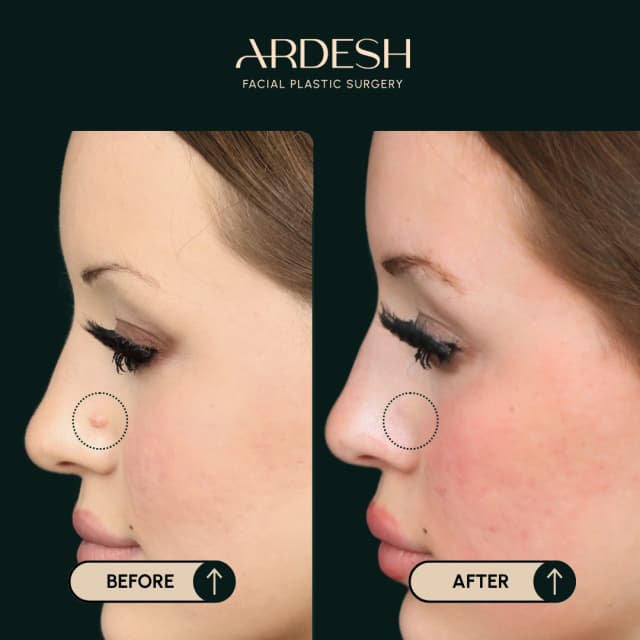
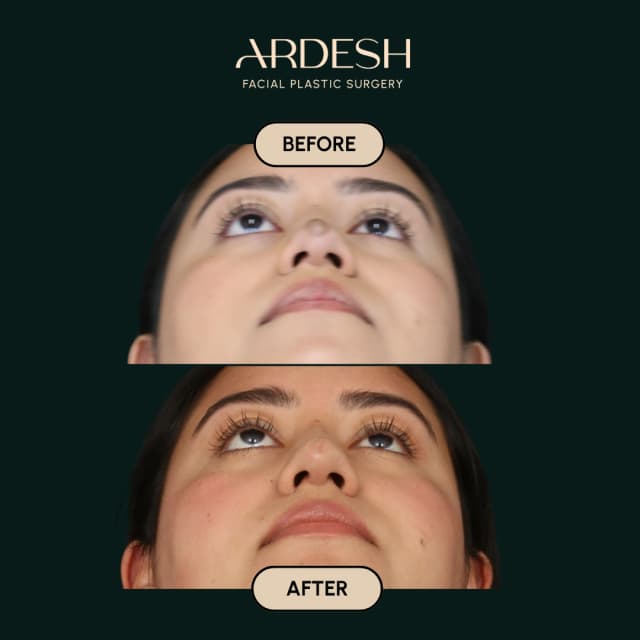
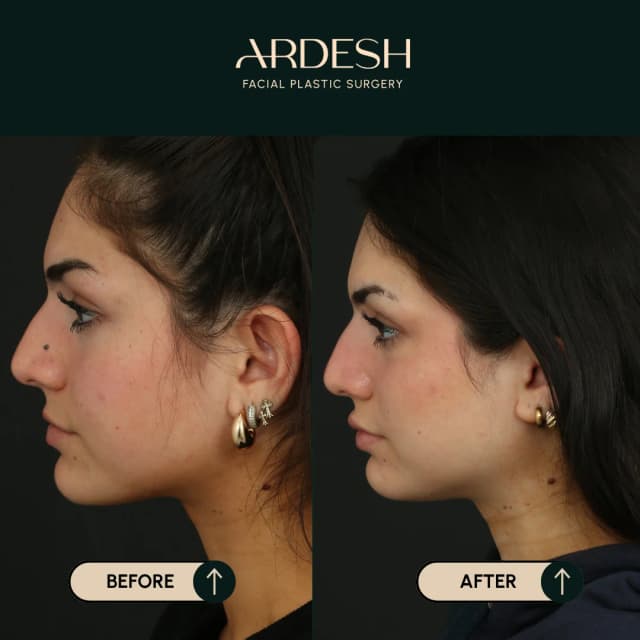
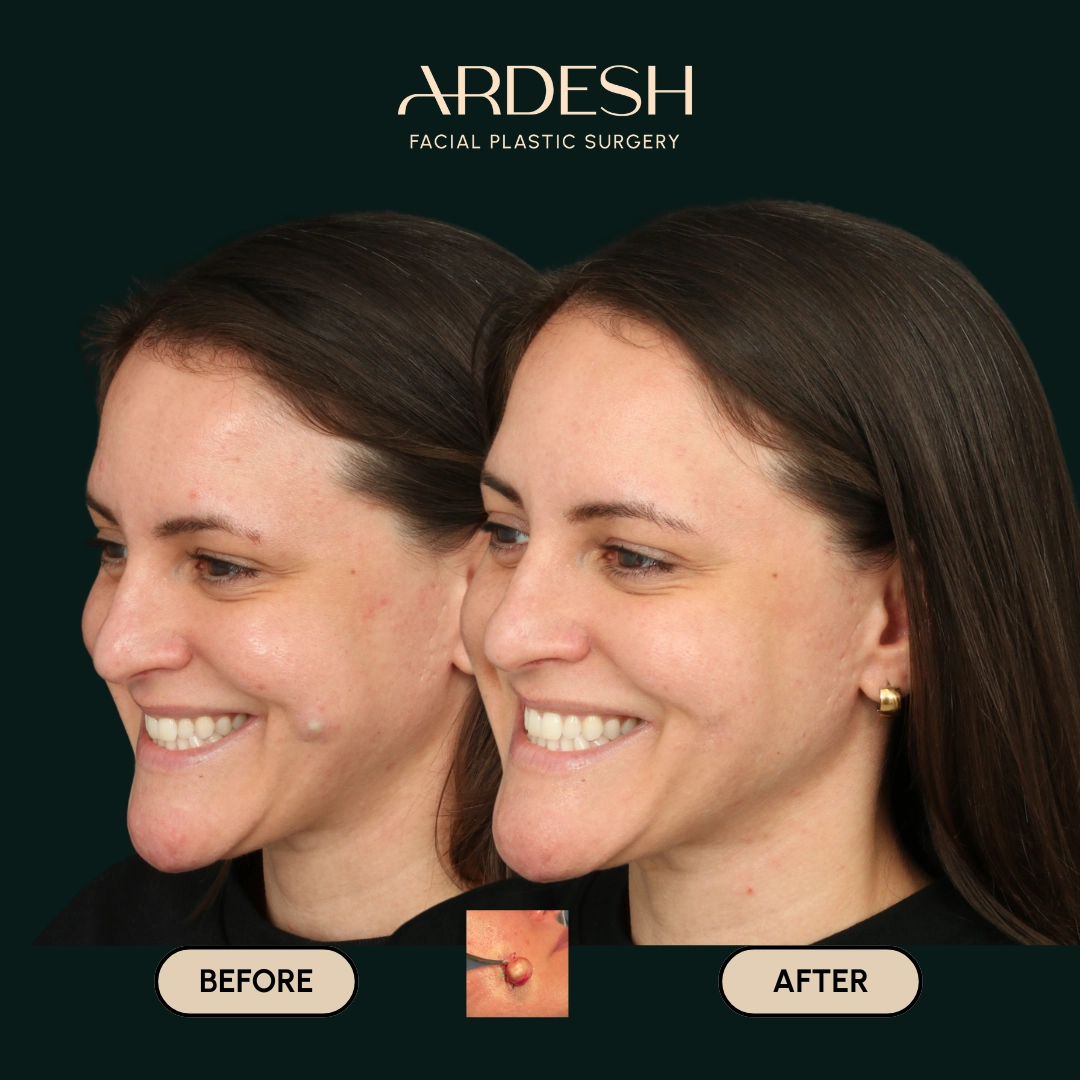
This distinction becomes particularly important when the lesion is on the face and the patient is concerned not only about diagnosis but also about the cosmetic quality of removal.
For patients considering treatment after an appropriate diagnosis, understanding when to consider mole removal can help clarify why some lesions may simply be monitored while others may warrant further evaluation or removal.
Concerned About a Facial Growth? Get the Diagnosis Right Before Thinking About the Scar
Being told that a lesion is harmless should reduce anxiety—but you are also entitled to understand what was diagnosed and why observation was recommended.
A stable, clinically typical skin tag ordinarily does not require removal simply because it exists. If a growth is changing, bleeding without obvious trauma, behaving unusually, or was never confidently identified, a repeat clinical evaluation is reasonable.
If the lesion is confirmed to be a mole and removal is recommended or chosen for appropriate reasons, the mole removal treatment approach can then be discussed with a qualified professional.
For patients specifically interested in facial lesions, facial mole removal also explains why surgical technique, incision placement, closure and scar management can influence the cosmetic result.
And if the lesion you are concerned about is actually a facial mole and cosmetic removal is appropriate, Dr. Ardesh provides specialised cosmetic mole removal through Beauty Mark MD™ in Beverly Hills and Newport Beach. His approach focuses on precise removal, careful incision placement, fine stitching, scar quality, and a natural result that blends with the surrounding skin.
Patients considering treatment in Beverly Hills can also learn more about mole removal in Beverly Hills before discussing their individual options with a qualified professional.
Do not begin with the assumption that every bump needs to come off. Begin with the correct diagnosis. If your concern involves a facial mole and you want to understand your cosmetic removal options, schedule a consultation with Dr. Ardesh to discuss the lesion and the aesthetic considerations involved in its removal.
Frequently Asked Questions
1. Is a skin tag dangerous?
A true acrochordon is generally benign and does not ordinarily have malignant potential. The more important issue is ensuring that an unusual lesion has been correctly identified as a skin tag rather than another type of skin growth.
2. Why would my doctor ignore a skin tag?
A physician may recommend leaving a typical skin tag alone because it is benign, asymptomatic, and does not medically require treatment. Observation is not necessarily neglect when the clinical diagnosis is clear.
3. When should a skin tag be checked again?
Seek medical reassessment if a lesion develops unusual or rapid growth, persistent unexplained bleeding, ulceration, significant changes in appearance, or if there is uncertainty about the original diagnosis. A clinician may recommend biopsy when the diagnosis remains unclear.
4. Can skin cancer look like a skin tag?
Certain other lesions can occasionally resemble an acrochordon, which is why atypical growths require appropriate differential diagnosis. This does not mean ordinary skin tags commonly represent cancer.
5. Can I cut off a skin tag at home?
Self-removal is not recommended, particularly when the diagnosis is uncertain. Improper removal can cause bleeding, infection, and tissue injury, and removing an unidentified lesion may eliminate the opportunity for appropriate medical assessment.