Discovering a new lump or raised spot on your skin can raise immediate questions. Is it a harmless mole? A skin tag? A cyst? Although these growths are common, they are not interchangeable. Each develops differently, has distinct characteristics, and may require a different approach to treatment.
When comparing a mole vs skin tag vs cyst, appearance alone is not always enough to identify what you are seeing. Some benign growths share features with lesions that require medical attention, making an accurate diagnosis the most important first step before considering removal.
This is particularly true for growths on the face and neck, where both diagnosis and treatment should prioritise not only your health but also the preservation of natural appearance.
About Dr. Ardesh
Dr. Ardesh of Beauty Mark MD is a double board-certified facial plastic and reconstructive surgeon known for delivering thousands of refined, natural outcomes. With an academic background that includes teaching in head and neck surgery, ophthalmology, and dermatology at Loma Linda University, he later transitioned into private practice to focus on patient-centred care. His philosophy emphasises subtle enhancement rather than obvious alteration, earning him recognition as a leading plastic surgeon in Beverly Hills and Newport Beach.
Why Skin Growths Are Often Misidentified
Many patients arrive believing they know exactly what a skin lesion is. A raised bump may be called a skin tag, while a dark spot is often assumed to be a mole. In reality, skin lesions can have overlapping features, and even experienced clinicians rely on careful examination rather than appearance alone.
The differences between a mole, skin tag, and cyst begin beneath the surface of the skin.
- Moles develop from pigment-producing cells known as melanocytes.
- Skin tags are small folds of excess skin that commonly develop where friction occurs.
- Cysts form beneath the skin when structures such as hair follicles become blocked, allowing material to accumulate over time.
Although these lesions are frequently benign, accurate identification is essential because certain skin cancers can occasionally resemble common, non-cancerous growths during their early stages.
Understanding the Differences: Mole vs Skin Tag vs Cyst
Moles
Moles are among the most common skin lesions and can appear anywhere on the body. They may be present from birth or develop gradually throughout life.
A mole may be:
- Flat or raised
- Brown, black, pink, or flesh coloured
- Smooth or slightly textured
- Round or oval with defined borders
Most remain unchanged for many years. However, any mole that begins to change in size, colour, symmetry, or border should be professionally evaluated.
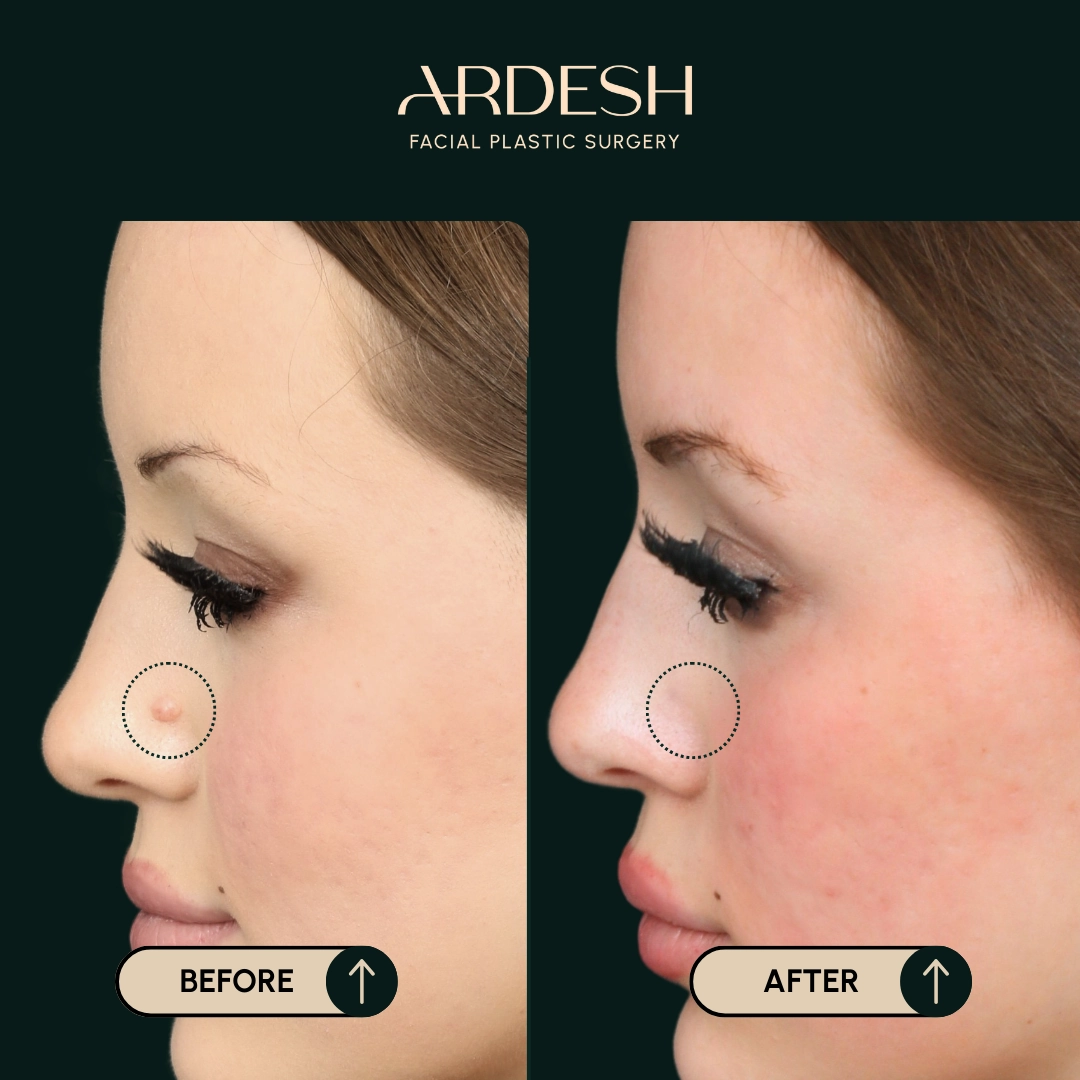
While many people seek mole removal for cosmetic reasons, particularly when lesions are located on the face, eyelids, nose, or lips, the priority is always confirming that the lesion is benign before discussing treatment options.
Skin Tags
Skin tags are soft, flexible growths that typically develop in areas where skin repeatedly rubs against itself.
They commonly appear on:
- The neck
- Eyelids
- Underarms
- Groin
- Beneath the breasts
Unlike moles, skin tags are usually attached by a narrow stalk and often move slightly when touched.
Although they are generally harmless, irritation from clothing, jewellery, or shaving may prompt patients to consider removal.
Importantly, not every small flesh-coloured growth is a skin tag. Certain skin cancers, including some forms of Basal Cell Carcinoma (BCC), may occasionally resemble benign lesions, reinforcing the importance of professional assessment.
Cysts
A cyst differs significantly from both a mole and a skin tag because it develops beneath the surface of the skin.
Most epidermoid (commonly called sebaceous) cysts form when skin cells become trapped beneath the skin rather than shedding normally. As these cells continue producing keratin, the cyst gradually enlarges.
Typical features include:
- A smooth, rounded lump beneath the skin
- Firm but movable texture
- Normal or slightly yellow skin colour
- Sometimes a visible central opening
Many cysts remain stable for years, while others enlarge, become inflamed, or occasionally become infected.
Unlike skin tags or moles, cysts often involve deeper tissue, meaning treatment usually requires complete removal of the cyst wall to reduce the likelihood of recurrence.
Comparing Mole vs Skin Tag vs Cyst
|
Feature |
Mole |
Skin Tag |
Cyst |
|
Origin |
Pigment-producing cells |
Excess skin |
Blocked skin or hair follicle |
|
Position |
Surface of the skin |
Surface of the skin |
Beneath the skin |
|
Texture |
Flat or raised |
Soft and flexible |
Firm and rounded |
|
Colour |
Brown, black, pink, or flesh coloured |
Usually flesh coloured |
Usually skin coloured |
|
Mobility |
Fixed within the skin |
Often moves on a narrow stalk |
Usually moves slightly beneath the skin |
|
Typical Concern |
Cosmetic changes or suspicious appearance |
Irritation or cosmetic concerns |
Enlargement, inflammation, or discomfort |
While this comparison provides helpful guidance, it should never replace clinical evaluation.
Can Appearance Alone Be Trusted?
One of the most common misconceptions is that skin growths can be accurately diagnosed by appearance alone.
In practice, this is not always possible.
Some benign lesions closely resemble one another, while certain skin cancers may initially appear surprisingly ordinary.
For example:
- A pigmented lesion may resemble a typical mole while displaying subtle features that warrant further investigation.
- A small flesh-coloured bump may look like a harmless skin tag but represent an entirely different diagnosis.
- A lump beneath the skin may be a cyst, but other benign or less common conditions can produce similar findings.
For this reason, experienced clinicians evaluate more than colour or shape alone. Factors such as growth pattern, texture, anatomical location, patient history, and clinical examination all contribute to establishing an accurate diagnosis.
When Should a Skin Growth Be Assessed?
Many benign lesions never require treatment. However, certain changes should prompt professional evaluation.
You should arrange an assessment if a lesion:
- Changes in colour
- Increases in size
- Develops irregular borders
- Bleeds without injury
- Becomes painful
- Frequently becomes irritated
- Shows persistent inflammation
- Begins changing after remaining stable for years
For pigmented lesions, clinicians often use the ABCDE guideline:
- A – Asymmetry
- B – Border irregularity
- C – Colour variation
- D – Diameter enlargement
- E – Evolving appearance
Although these features do not automatically indicate skin cancer, they help identify lesions that deserve further evaluation.
Treatment Depends on an Accurate Diagnosis
Although many skin growths are benign, there is no single treatment that is appropriate for every lesion. Management depends on establishing an accurate diagnosis first, followed by selecting the approach that best addresses both medical and aesthetic considerations.
Mole Removal
Moles may be removed for cosmetic concerns, recurrent irritation, or when further pathological evaluation is recommended. On the face, careful surgical planning is particularly important to minimise visible scarring while preserving natural facial contours.
Skin Tag Removal
Skin tags are often removed when they become irritated by clothing or jewellery or when they affect appearance. In experienced hands, removal is typically performed as a straightforward office-based procedure with attention to achieving the best possible cosmetic outcome.
Cyst Removal
Small cysts that remain stable and symptom-free may simply be monitored. However, cysts that enlarge, become inflamed, repeatedly become infected, or cause cosmetic concerns often require surgical removal. Complete excision of the cyst lining helps reduce the likelihood of recurrence.
Regardless of the type of lesion, treatment decisions should never be based on assumptions or self-diagnosis. Establishing exactly what the growth is remains the most important step before discussing removal.
If your skin growth turns out to be a mole rather than a skin tag or cyst, the next question is often whether it needs treatment at all. While many raised facial moles are completely benign, some deserve closer evaluation if they begin to change or become bothersome. Understanding the difference between cosmetic removal and situations that require medical assessment can help you make a more informed decision. You may also find it helpful to learn why many patients specifically choose a Facial Plastic Surgeon vs Dermatologist Mole Removal approach when cosmetic appearance and scar quality are important considerations, as well as our guide on Raised Mole on Face Removal.
Why Facial Plastic Surgery Expertise Matters
Removing a skin lesion from the face involves more than simply eliminating the growth. Every incision has the potential to influence facial balance, skin texture, and the visibility of a scar.
As a board-certified facial plastic surgeon, Dr. Farhad Ardesh approaches each case with an understanding of facial anatomy, skin tension lines, and aesthetic proportion. Whether evaluating a mole, skin tag, or cyst, his recommendations are guided by two equally important priorities: confirming an accurate diagnosis and achieving the most natural cosmetic result possible.
This thoughtful approach is particularly valuable for lesions located on highly visible areas such as the eyelids, nose, lips, cheeks, jawline, and neck, where even minor differences in surgical technique can influence the final appearance.
Final Thoughts
Understanding the differences between a mole vs skin tag vs cyst can help you recognise when a skin growth deserves professional attention, but appearance alone rarely provides a definitive diagnosis. While many lesions are harmless, others require further evaluation before treatment is considered.
Attempting to identify, or remove, a lesion yourself may delay diagnosis, increase the risk of scarring, or overlook a condition that warrants medical attention. A thorough clinical assessment ensures that treatment decisions are based on evidence rather than assumption.
If you have noticed a new skin growth or are considering the removal of a mole, skin tag, or cyst on the face or neck, consulting an experienced facial plastic surgeon is an important first step.
Schedule a Consultation with Dr. Farhad Ardesh
Every patient deserves an evaluation that prioritises both safety and aesthetic outcomes. Dr. Farhad Ardesh develops personalised treatment plans based on careful clinical assessment, facial anatomy, and the unique characteristics of each lesion. Whether your concern is cosmetic, functional, or diagnostic, every recommendation is made with the goal of preserving your natural features while achieving the best possible result.
To learn more about Dr. Ardesh's approach to facial lesion assessment and cosmetic mole removal, or to schedule a personalised consultation.
Discover The Molectomy™ Method by Beauty Mark MD™
The Molectomy™ Method by Beauty Mark MD™ is our signature approach to cosmetic mole removal and beauty mark refinement. Designed to prioritize natural-looking results, scar minimization, advanced healing, and facial harmony, it offers a refined solution for patients seeking comprehensive facial enhancement.
FAQs
1. How can I tell the difference between a mole, a skin tag, and a sebaceous cyst?
Moles are usually pigmented brown or black spots that may be flat or raised. Skin tags are soft, flesh-coloured growths that often hang from the skin. Sebaceous cysts are firm, round lumps beneath the skin that can sometimes have a visible central pore or small dark spot.
2. Are moles, skin tags, and sebaceous cysts dangerous?
Most moles, skin tags, and sebaceous cysts are benign. However, a mole that changes in size, colour, shape, or starts bleeding should be evaluated by a healthcare professional. Cysts can occasionally become infected, while skin tags are generally harmless.
3. Can I remove a mole, skin tag, or cyst at home?
Home removal is generally not recommended, particularly for facial or neck lesions. Incorrect removal can lead to infection, incomplete treatment, scarring, or delayed diagnosis of a more serious condition.
4. When should I seek medical advice about a skin growth?
You should consult a medical professional if a growth changes appearance, becomes painful, bleeds, becomes infected, grows rapidly, or if you are uncertain about what it is. Accurate diagnosis is important before considering removal.
5. What treatment options are available for moles, skin tags, and sebaceous cysts?
Treatment depends on the type of growth. Skin tags can often be removed with simple procedures, moles may require surgical excision for cosmetic or medical reasons, and sebaceous cysts may be monitored or surgically removed if they become symptomatic or bothersome.