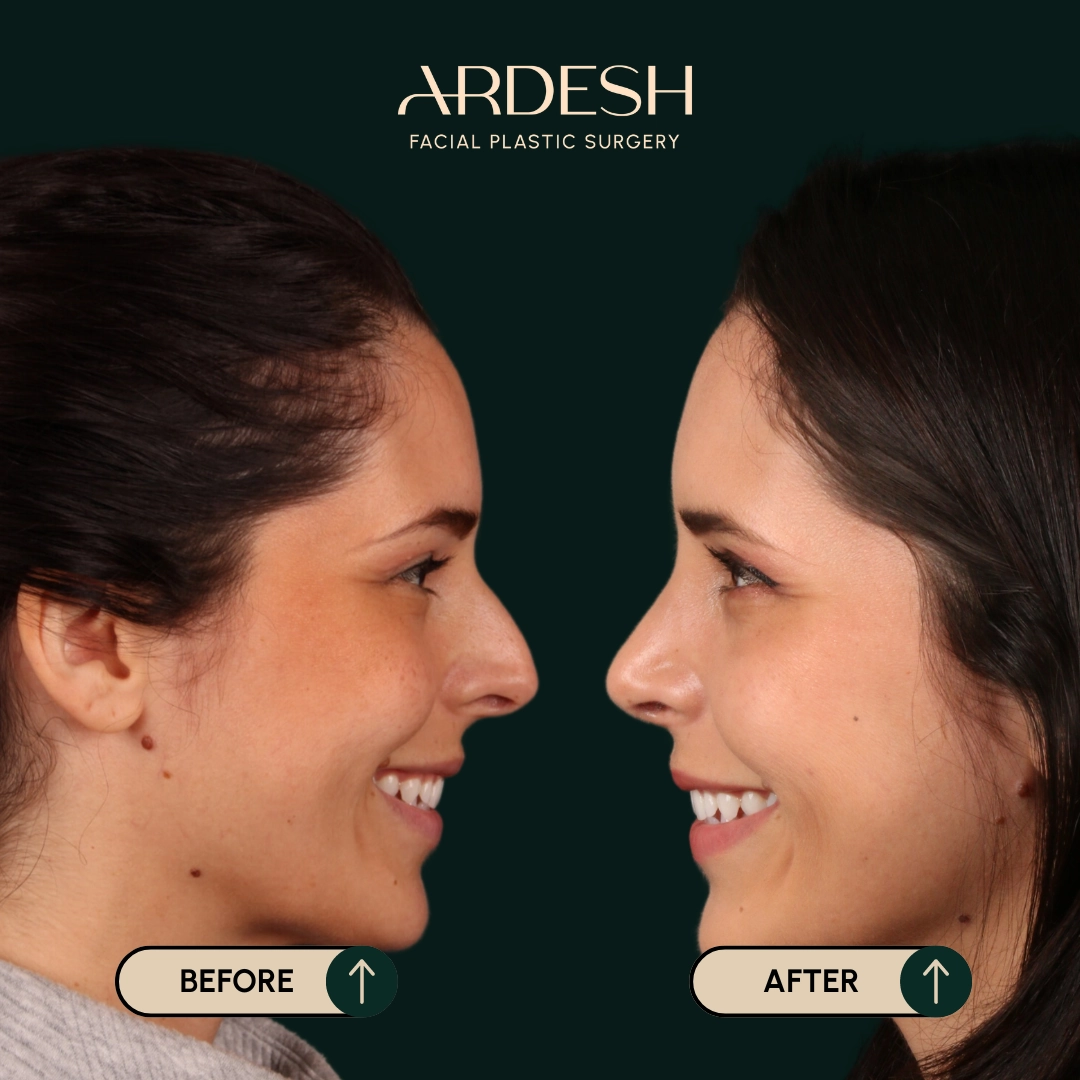
Your nose may look perfectly acceptable when your face is relaxed, yet the tip seems to point downward the moment you smile. That change is real. It is often described as a dynamic drooping nasal tip because it becomes more noticeable during facial movement rather than remaining identical at rest.
Research has shown that the muscles around the nose and upper lip can influence nasal tip position during smiling. One muscle in particular, the depressor septi nasi, can contribute to downward movement of the tip in some people.
The important question is not simply whether your tip droops. It is why it happens in your nose.
About Dr. Ardesh
Dr. Ardesh of Beauty Mark MD is a double board-certified facial plastic and reconstructive surgeon known for delivering thousands of refined, natural outcomes. With an academic background that includes teaching in head and neck surgery, ophthalmology, and dermatology at Loma Linda University, he later transitioned into private practice to focus on patient-centred care. His philosophy emphasises subtle enhancement rather than obvious alteration, earning him recognition as a leading plastic surgeon in Beverly Hills and Newport Beach.
Why Can Smiling Change the Position of the Nasal Tip?
Smiling activates several muscles around the mouth and nose.
In some people, this movement produces very little visible change. In others, the tip moves noticeably downward while the upper lip rises. Studies examining this pattern have linked the change to dynamic muscular forces as well as the structural support of the nasal tip.
This explains why a nose can look different in a posed photograph compared with a picture taken while laughing.
It also means that evaluating only a still image may miss an important part of the concern.
Is It the Same as Having a Naturally Droopy Nose?
No.
A tip that already points downward when the face is relaxed is different from one that changes mainly during smiling.
Some patients have a static tip position, influenced primarily by cartilage shape, support and other anatomical features.
Others have a greater dynamic component, where facial movement exaggerates downward rotation.
Some noses have elements of both.
Recognising the difference matters because the surgical plan should address the actual cause rather than treating every drooping tip in the same way.
A Simple Detail Worth Showing Your Surgeon
If this issue bothers you, bring photographs showing your face both relaxed and smiling.
Better still, demonstrate the movement during the consultation.
Research into rhinoplasty and smile dynamics supports assessing nasal tip behaviour during facial animation rather than relying entirely on the resting position.
A surgeon may look at:
- how far the tip moves
- tip projection and rotation
- cartilage support
- the relationship between the nose and upper lip
- whether the appearance changes only during a full smile
That provides more useful information than simply saying, “I want my tip lifted.”
Can Rhinoplasty Correct a Tip That Drops When You Smile?
Rhinoplasty may improve this concern in appropriately selected patients, but there is no single technique that applies to everyone.
Research has evaluated approaches that address nasal tip support as well as muscular forces contributing to downward movement. One study found that combining structural tip support with treatment of the depressor muscle produced greater improvement in smile-related tip droop than muscle treatment alone in the patients studied.
More recent clinical research has also examined methods designed to reduce dynamic tip movement during smiling.
The relevant point for a patient is simpler:
The surgeon first needs to determine whether the problem comes mainly from movement, structural support, tip position or a combination of factors.
The operation can then be planned around that anatomy.
Patients who are unsure whether surgery is necessary may also find it useful to understand the difference between non-surgical nose reshaping vs rhinoplasty.
If surgery is being seriously considered, understanding the typical rhinoplasty recovery timeline can also help set realistic expectations before treatment.
Does the Tip Need to Be Turned Up?
Not automatically.
Someone who dislikes a downward-moving tip may assume the answer is an obviously upturned nose. Those are two different goals.
The desired position needs to work with the person's bridge, upper lip, facial proportions and natural nasal anatomy.
This broader idea of how rhinoplasty enhances facial balance is important when planning tip position rather than focusing on the nose in isolation.
For many patients, the aim is simply for the tip to remain in a more balanced position when their expression changes.
That distinction is worth making clear during a rhinoplasty consultation.
What Should You Look for in Before-and-After Photos?
When reviewing rhinoplasty before-and-after results, do not judge this particular concern using profile photographs taken only with a neutral expression.
If smile-related movement is your main problem, ask whether comparable cases can be viewed in both resting and animated positions.
Patients can also review the rhinoplasty gallery to better understand the type of changes that may be possible, while keeping in mind that every nose has different anatomy.
A technically attractive resting profile does not tell you how the nose behaves when the patient smiles.
For this concern, movement matters.
Can Rhinoplasty Change the Way You Smile?
The nose and upper lip have anatomical and muscular relationships, which is why smile behaviour deserves consideration during surgical planning. Research examining the depressor septi nasi specifically describes its relationship with nasal tip movement and upper-lip position.
This does not mean everyone undergoing nasal tip surgery will experience the same change.
It means that if your smile is one of the reasons you are seeking treatment, mention it before surgery, not afterward.
When Is a Consultation Worthwhile?
Consider an assessment when the downward movement is consistently noticeable to you in photographs, videos or everyday expressions and you want to understand whether anatomy can be changed surgically.
Patients researching rhinoplasty in Orange County can discuss this specific concern with Dr. Ardesh rather than requesting generic tip refinement.
During the consultation, show exactly what happens when you smile. That allows the discussion to focus on the feature you actually want changed and whether a realistic surgical option exists.
If your nose looks different when you smile, bring both relaxed and smiling photographs to your consultation with Dr. Ardesh so the nasal tip can be evaluated in motion as well as at rest.