One of the most common questions patients ask during neck lift consultations is whether the procedure can be performed without general anesthesia. Concerns about anesthesia are understandable and often stem from previous surgical experiences, medical considerations, recovery expectations, or a desire to minimize procedural intervention.
When we start searching for Neck lift local anesthesia.
The answer depends on several factors, including the degree of neck aging, the extent of correction required, patient comfort, overall health status, and the specific surgical techniques being performed. While certain neck rejuvenation procedures may be appropriate under local anesthesia or local anesthesia with sedation, others may require a different anesthetic approach to ensure patient safety, comfort, and optimal surgical precision.
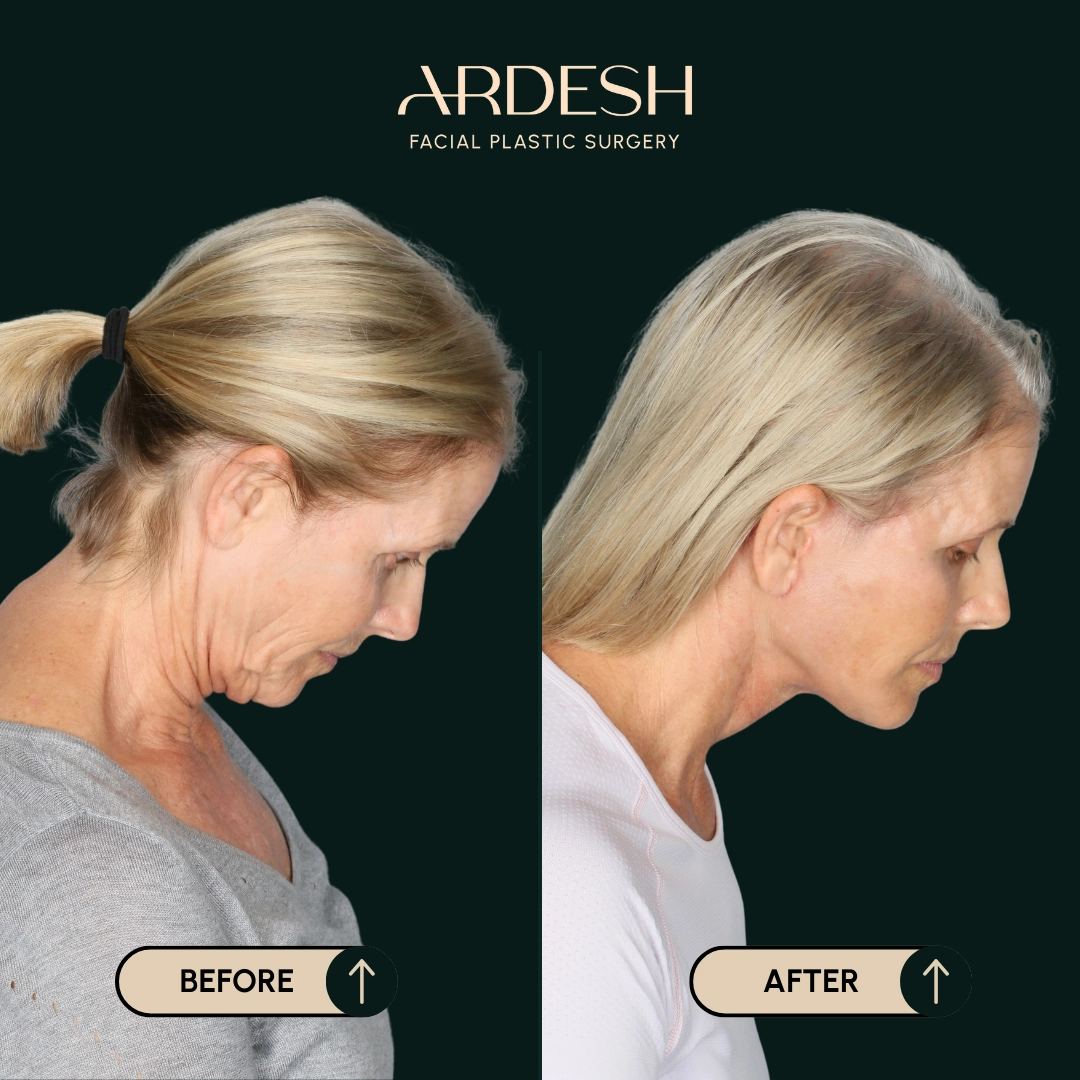
Importantly, anesthesia decisions are not made independently of the procedure itself. Before discussing anesthesia options, surgeons must first identify the anatomical causes of the patient's concerns. Neck aging may result from submental fat accumulation, skin laxity, platysmal banding, loss of jawline definition, or a combination of these factors. Each presents unique treatment considerations that can influence surgical planning.
This article explains when neck lift procedures may be performed without general anesthesia, how surgeons determine candidacy, and the factors that influence the safest and most effective treatment approach for each patient.
About Dr. Ardesh
Dr. Ardesh of Beauty Mark MD is a double board-certified facial plastic and reconstructive surgeon known for delivering thousands of refined, natural outcomes. With an academic background that includes teaching in head and neck surgery, ophthalmology, and dermatology at Loma Linda University, he later transitioned into private practice to focus on patient-centred care. His philosophy emphasises subtle enhancement rather than obvious alteration, earning him recognition as a leading plastic surgeon in Beverly Hills and Newport Beach.
The neck doesn't age the same way for everyone
One patient develops fullness beneath the chin. Another develops loose skin. Someone else notices neck bands becoming more visible when speaking or smiling.
All three people may describe their concern the same way:
"My neck looks older."
But the underlying cause is completely different.
That's why two patients can walk into a consultation asking for exactly the same thing and leave with different recommendations.
Before discussing anesthesia, surgeons are usually trying to answer a more important question:
"What are we actually treating?"
Common findings include:
- Excess fat beneath the chin
- Loose skin in the neck
- Visible neck bands
- Loss of jawline definition
- A combination of several concerns
Once the cause becomes clear, the discussion about treatment and anesthesia starts making much more sense.
Identifying the anatomical cause of neck aging is often the most important step in treatment planning. Our article "Neck Lift vs. Facelift vs. Neck Liposuction: Which One Actually Fixes YOUR Problem?" explains how surgeons distinguish between these procedures based on skin laxity, fat accumulation, muscle anatomy, and lower facial aging.
Why people become interested in local anesthesia
For many patients, local anesthesia feels less intimidating.
It sounds simpler. It sounds easier. And sometimes, for the right patient, it may be an appropriate option. But there's a misconception that local anesthesia is automatically better because it sounds less invasive.
That's not necessarily how surgical planning works. A surgeon's goal is not to choose the smallest amount of anesthesia possible. The goal is to choose the safest and most effective approach for the procedure being performed. Those are two different things.
Understanding the role of a mini neck lift
The term mini neck lift has become extremely popular online.
Part of the appeal is the name itself.
The word "mini" suggests something quick and simple. Patients often associate it with:
- Smaller incisions
- Shorter recovery
- Less downtime
- Less anesthesia
Sometimes those assumptions are partially true.
Sometimes they're not.
A mini neck lift generally refers to a more limited correction intended for patients with earlier signs of neck aging. It may be considered when changes are noticeable but not particularly advanced.
Patients exploring a mini neck lift often describe concerns such as:
- Early jawline softening
- Mild neck laxity
- Slight skin looseness
- Early aging beneath the chin
The important thing to remember is that "mini" describes the scope of correction. It doesn't automatically determine the type of anesthesia used.
These early signs of neck aging commonly become noticeable during the fourth and fifth decades of life. In "Turkey Neck at 40 – Is It Too Early for a Neck Lift or the Perfect Time?" we discuss how surgeons evaluate whether anatomical changes warrant treatment regardless of a patient's chronological age.
Can a neck lift be performed under local anesthesia?
In selected situations, yes.
But this is where internet research often becomes misleading.
People read a success story online and assume the same approach applies to everyone.
It doesn't.
The suitability of Neck lift local anesthesia depends on several factors:
|
Consideration |
Why It Matters |
|
Degree of neck aging |
More extensive correction may require a different approach |
|
Skin laxity |
Significant laxity may increase procedural complexity |
|
Patient comfort level |
Some individuals tolerate procedures differently |
|
Medical history |
Health considerations always matter |
|
Surgical goals |
Desired outcomes influence treatment planning |
The answer isn't determined by a single variable.
It's determined by the entire picture.
The question patients often forget to ask
Most consultations begin with:
"Can I avoid general anesthesia?"
Few begin with:
"What approach is most likely to give me the result I'm hoping for?"
That's usually the more useful question. Imagine spending months researching anesthesia only to discover that the procedure you actually need is different from the one you assumed.
It happens more often than people realize. Patients sometimes arrive focused on anesthesia and leave focused on anatomy. They discover that the real issue isn't anesthesia at all. It's understanding what is causing the neck to look older.
In many cases, patients are still determining whether surgery is necessary at all. Our article "Can Exercise Fix a Saggy Neck or Do You Actually Need Surgery? A Surgeon Answers" explores when lifestyle modifications and non-surgical approaches may be reasonable and when structural aging changes require surgical correction.
Is local anesthesia safer?
This is where things become nuanced. Many patients assume avoiding general anesthesia automatically makes a procedure safer. Medicine rarely works that way.
Safety depends on context. For the right patient and the right procedure, Neck lift local anesthesia may be entirely appropriate.
For another patient, a different anesthesia plan may create a more controlled, predictable, and comfortable experience.
That's why surgeons evaluate far more than the neck itself.
They consider:
- Overall health
- Surgical complexity
- Recovery expectations
- Patient comfort
- Treatment goals
Safety comes from proper planning.
Not from choosing one anesthesia type over another simply because it sounds easier.
What surprises patients after a consultation
Most people expect the conversation to revolve around anesthesia. Instead, it often revolves around options. Some patients learn they are candidates for a mini neck lift when they expect something more extensive.
Others discover that their concerns involve both the neck and jawline. Some realize they need less treatment than they initially thought. And occasionally, patients find out that the solution they were researching online isn't the best match for their anatomy.
That's not bad news. It's useful information. The purpose of a consultation isn't to confirm what Google suggested. It's to understand what will realistically address the concern.
The bottom line
Whether a neck procedure can be performed under Neck lift local anesthesia depends on the individual patient, the degree of correction required, and the overall treatment plan. There is no universal answer because neck aging doesn't look the same from one person to the next.
For patients considering a mini neck lift or exploring anesthesia options, a personalized evaluation can provide clarity that online research often cannot. At Dr. Ardesh's practice, treatment recommendations are based on anatomy, patient goals, and achieving natural-looking results that fit the individual rather than a predefined formula.
Discover The Molectomy™ Method by Beauty Mark MD™
The Molectomy™ Method by Beauty Mark MD™ is our signature approach to cosmetic mole removal and beauty mark refinement. Designed to prioritize natural-looking results, scar minimization, advanced healing, and facial harmony, it offers a refined solution for patients seeking comprehensive facial enhancement.
FAQs
1. Can a neck lift be performed entirely under local anesthesia?
In selected patients, certain neck rejuvenation procedures may be performed using local anesthesia with or without oral or intravenous sedation. Suitability depends on the extent of correction required, patient comfort, medical history, and surgical complexity.
2. Does avoiding general anesthesia make a neck lift safer?
Not necessarily. Safety depends on multiple factors, including patient health, procedural requirements, monitoring protocols, and surgical planning. The safest anesthesia approach is the one most appropriate for the individual patient and procedure.
3. Who may be a candidate for a neck lift under local anesthesia?
Patients with relatively limited neck aging, good overall health, realistic expectations, and concerns that can be addressed through less extensive surgical correction may be candidates. Determination requires an in-person evaluation.
4. Can a mini neck lift be performed under local anesthesia?
In some cases, yes. However, the term "mini neck lift" refers to the extent of correction rather than the anesthesia method. Not all mini neck lift procedures are performed under local anesthesia, and candidacy varies by patient.
5. What factors influence anesthesia selection for neck rejuvenation surgery?
Surgeons typically consider the degree of skin laxity, presence of platysmal banding, amount of submental fat, overall surgical goals, patient health, anxiety level, and anticipated procedure duration when determining the most appropriate anesthesia plan.